I don’t know, I can imagine quite a bit…

For much of my life, I’ve been a pretty passionate person, a PPP, if you will. Not a “pretty” person who’s passionate, but… you know what I mean. I live well when I’m passionately pursuing purpose. A PPP PPP-ing. Okay, enough of that pointless, preposterous poppycock. 

I’m not a philosopher with a well-thought-out-but-poorly-written existentialist work. I don’t have a theory of life called Forrester-ism. Forrestism? Forrestianism? Anyway, I don’t have a well-defined system, but I have generally sought to live passionately. I want to have a passion and live fully for it. I want to put my “all” into something. I want to be engaged, focused, and striving for excellence in something. That’s a passionate life and that’s a good way for me to live. Like anyone else, I sometimes live well and sometimes I don’t live well. 

The first problem I’ve encountered is this: what is the something that you’re striving towards? What are you passionately putting your “all” into? Is it a creative passion, such as painting or making music? Or maybe it’s your job or academic field? Maybe you want to be the best dentist you can be, or study coral reefs, or bake the best cookies ever, or design cool bikes. But sometimes it’s more narrow, like you want to win a specific championship or win a certain award or love that one person? That leaves you open to the possibility that you’ll lose. But you still have to continue on. 

Another problem is how high we set our sights. Theoretically we can set our sights at infinity, and accept where we land. “I want to paint, so I set my sights on the ultimate, infinitely good, perfect painting ability. I strive towards that for my life, and however good my paintings are, that’s that.” I kind of like this idea because of its simplicity. I’m passionate about X, so I’ll strive for the ultimate version of X, and that’s it. That’s how we got Michelangelo, Mozart, and… Michael Jordan? I don’t know, I was going for a triple, single-named alliteration but I couldn’t think of another single-named “M” person that’s among the best in their field.

Anyway, Michelangelo painted awesome paintings, Mozart composed awesome compositions, and Michael Jordan basketed some awesome balls. They were all passionate about those things, they set their sights high, and they did pretty well. But, you know, Michael Jordan wasn’t practicing basketball at every moment of every day. He loves golfing and gambling and making money from shoe sales [who made the shoes, anyway?], so he was always making decisions about how much to train, how much to practice, how much to relax, how much to golf, how much to enjoy his money, and so on. That’s not even a unique feature of my prescribed passion-filled life. Decision-making is a curse we all endure. 

The point is that you can’t [and shouldn’t] do just one thing at all times. Like I can sit here and say, “Hey, I like writing. I write books. I wanna be a great writer. That’s my passion. Everything I do is about writing. There’s nothing else.” Can’t really do that. Yes, it’s my passion, but I still have to eat food, so I’d like the food to be kinda good and kinda healthy. I still have to go places, so I’d like to have a cool bike or something. What I’m trying to say is that, no matter what your passion is, there will always be surrounding things in your life, like where you live, how much money you have, whether or not you have a cool bike. The “meat and potatoes” of your life, so to speak. 


You want it to be good, you hope it’s good, you work hard to make it good, but you can always imagine it all as the perfect, ultimate version of it. I could walk to the store, buy a ticket for $2, and win $100 million. With that I could get a better apartment in a nicer place, a cool bike, and I could ride it around and such. But it’s foolish to expect that to happen, obviously. I can imagine the nicest apartment, the coolest bike, the perfect partner, nice neighbors and so on. I can imagine everything going perfectly for me, but it’s not going to, so I’m left with this difficult balance between trying for my best life and accepting/enjoying the life I currently have. For me, that imagining, that envisioning of success and achievement and a better life is part of what drives me to do it. So I gotta imagine to get myself going, but I can’t imagine too much cause that kinda fucks me up. Shit’s tough, man. I’ll work on it. I’LL BE BACK AND BETTER THAN EVER, maybe.

People Already Think You’re Stupid

You know, sometimes I feel some hesitancy about putting myself out there. My writing, my opinions, my videos, myself in general. It can be tough to fully put yourself out there. If I put my thoughts, opinions, convictions, beliefs out there, people might think I’m stupid. If people think I’m stupid, I will feel bad. Pretty simple chain of events and feelings. Unfortunately, whether you choose to put yourself out there or not, people already think you’re really, really stupid. 

A lot of people already think I’m stupid, too. Let’s look at a fun example: Mark Sargent. He is one of the most prominent figures in the modern Flat Earth movement, which gained notoriety and attention in 2017-2019, but has since died down significantly. Sargent is a flat earth evangelist. His goal is to convert people into his belief system. Now, if you’ve spent any amount of time listening to similar conspiracy believers, you’ll know that they think too highly of nonbelievers. They often use words such as sheep, brainwashed, mindless drone, and so on. Because I say that the Earth is a spheroid, Mark Sargent and his followers think I’m stupid. They think I’m just a brainless, thoughtless idiot who believes and regurgitates everything he hears. Obviously that’s not true, but they think that about me. 

Now, some point to flat-earthers as a way to boost their own self-esteem. “When I feel down, I think of flat earthers, and by comparison I now feel better about myself.” I try to avoid doing that. I do not think it is a good way of thinking about all of this. My point is this: by simply accepting the curvature of the Earth, you already have thousands of people thinking you’re stupid. There are plenty of examples of this, where one simple, reasonable belief results in a bunch of people thinking that you are stupid. To completely avoid accusations of stupidity is impossible, and any attempt to do so is futile. So you might as well put yourself out there with your art, writing, beliefs, and so on.

HOWEVER [there’s always a ‘however’], there is a danger in going too far the other way. Our first extreme is when you’re so terrified of people thinking your’e stupid that you’re crippled into inaction, and you don’t express yourself. That extreme, as we’ve said, is bad. Don’t do that. The other extreme is to say, “Well, people will always think I’m stupid, so I’ll put myself out there completely and confidently. And anyone who calls me stupid can be dismissed just as the flat earthers can be dismissed.” Here’s the problem with that: sometimes you are stupid. And you need to be told that you’re being stupid. 

I’ve been stupid plenty of times, about plenty of things. And I needed to be told, directly or indirectly, that I was being stupid. Once I understood my stupidity, I was able to grow out of it. Though I’m sure I still have some stupidities. I’ll get rid of those later.

So what? Am I advocating for some kind of middle ground? Some balance? Kind of, but kind of not. I don’t think of it as two extremes with a line segment between them, and you just have to find the center point. I think of it more as the two extremes are the points at the base of a triangle, and the best way to be is the top of the triangle. So, if you’re at one extreme, you can’t just go towards the other extreme, you gotta go in a unique direction to get to a good place.

If that’s too conceptual and geometric for you, well, I think we still explored some good points that the two extremes are both bad. Don’t do them. And if you consider the situation to be two points and a middle ground, so be it. Just don’t let fear prevent you from speaking up, and don’t let confidence prevent you from admitting when you’re wrong.

High Movie Review #14: Dr. Strangelove

All right, it’s about time to write about this movie. It’s one of my favorites of all time, I’ll just say that right out. So it was directed by Stanley Kubrick, who is kind of a strange, dark, genius type of guy. And it was released in January of 1964, which was just 15 months after the Cuban Missile Crisis. So that’s right in the era of the height of nuclear tensions. There was serious concern about the possibility of nuclear war. There’s some posturing now about how we might, this time, engage in a nuclear war. That would be, in a word, bad. That’s my opinion, anyway. That would be bad.

Anyway, let’s get to the movie. Great opening credits, showing planes flying in the sky. These giant metal objects flying around. Really crazy, I mean, civilizations have been around for thousands and thousands of years. For that whole time, and even earlier, we’ve wanted to fly. We look at birds, and we want to do what they’re doing. And yeah, we can’t do it on a personal, physical level, but we’ve been able to build these big metal rooms in which we can fly. We wanted to do that the whole time, but it took our species like 200,000 years to figure out how, but then think how significantly it advanced from the Wright brothers to the time that this movie was released. It’s an insane advancement in 60 years. Then we went to the moon 5 years after that. Insane. Technology is just advancing at incredible speeds without any brakes, completely out of control, and will probably lead to our ultimate demise.

Anyway anyway, General Buck Turgidson gets a phone call informing him that some Brigadier General Jack D. Ripper [get it?] initiated Plan R, a nuclear attack against Russia. So there were bombers flying around, he ordered the attack, then they start flying towards their different targets in Russia. The idea is that the Russians could just kill the President and wipe out the U.S.A.’s ability to order nuclear attacks. So certain generals were given the ability to order nuclear attacks. In the movie, they trusted no one to simply go fucking crazy and order genocide. Foolish! Eventually someone’s gonna do that.

The bombers can be recalled, but only by sending a message with a three-letter prefix, so that the Russians can’t send phony recall messages. Only Ripper knows the code. So the movie basically follows three groups. First, the war room, where the President, Turgidson, and other generals try to figure out what to do. Second, Ripper at his Air Force base. Third, the crew of one of the bombers. 

Peter Sellers gives an amazing performance as three characters in this film. My favorite acting performance of all time. First, we have the British guy, Mandrake, who is trying to get the code prefix from Gen. Ripper. And there’s a moment early one where Mandrake realizes that Ripper has gone crazy. And Mandrake just says, “Oh…” and the way he says it, so fuckin funny. I imitate that moment all the time. 

Then we have the guys in the plane, captained by Slim Pickens [a hilarious stage name]. He’s a good ol’ southern boy, and he even wears a cowboy hat. Great character. And he says stuff like “Russkies,” or however you spell it. I’ve heard this character was also supposed to be played by Sellers, but I’m glad that it went to Pickens. He’s the perfect. These scenes are often scored with humming Johnny Comes Marching Home, with an ominous drum. It really creates a sense of marching towards your ultimate fate, if that even exists.

Ripper embodies the most extreme form of McCarthyist paranoia. The commies! The international communist conspiracy! It’s largely that fear that resulted in millions of death in places like Vietnam and, well, much of South America. History is really quite tragic. I remember a quote from former Vice President Henry Wallace, a hopeful quote about how the U.S.S.R. and U.S.A. would gradually become more alike, with each taking the good parts from the other. But, you know, didn’t really happen that way. 

Anyway, Sterling Hayden and Peter Sellers are kind of a duo, and they’re so good in their dialogue. Sellers as the flustered Englishman, and Hayden as the crazy war hawk. His entire life is war, so his only solution to the world is war, and he aims to be better at it.

The other incredible duo is Sellers as President Muffley and George C. Scott as Turgidson. The President interrogates Turgidson about the situation and realizes that they’re basically fucked, and the attack is ongoing. So the President is like “This whole nuclear plan is fucked up, and it’s totally fucking up!” And Turgidson replies “I don’t think it’s quite fair to condemn the whole program because of a single slip-up.” A single slip-up! A hilariously reductionist explanation of nuclear holocaust. It was just a slip-up. It’s like when people say “everyone makes mistakes,” like, yeah, no one can really dispute that, but what’s the mistake in question? 

So Ripper’s idea is that he’ll execute plan R, then the President and top generals will realize that it can’t be stopped, so their only option will be to go even further with a nuclear attack, destroying as much of Russia as possible to avoid their retaliation. Turgidson falls right into line with that plan. He kind of gives a utilitarian type of argument, saying that they can either have 20 million people killed or 150 million killed. It’s interesting to think about these types of calculations being made during the Cuban Missile Crisis a couple years before. Considering what cities would be most likely to be destroyed in whatever situations, how many millions of people would be killed if we do this or that. Meanwhile most of those people are just trying to get by, just trying to live their lives.

The President takes a different route. He’s like, “Well, we’re kind of fucked, but let’s try to invade Ripper’s base to get the recall code, and at the same time we’ll just tell the Russians what’s going on so they can shoot down the bomber planes.” That way, [hopefully] no one gets nuked. Just a few hundred people get killed instead of millions. 

So he calls the Russian premier, who is drunk [LOL], and tells him what’s going on. It’s such a funny phone call. Sellers is a fuckin genius. He mixes the small talk, friendly phone call etiquette bullshit with the extremely serious issue of nuclear war. It’s so funny. “Of course I like to speak with you! Of course I like to say ‘hello!’” And arguing about who’s more sorry for the situation. The world hangs in the balance! Yet they get into this weird etiquette game. I love it. Then the Russian ambassador learns about their doomsday machine, which is the ultimate nuclear weapon that will destroy all human and animal life if it is triggered. And it’s triggered by an attack.

The Russian doomsday machine is the embodiment of the ‘mutually assured destruction’ argument of nuclear weapons. The idea is that if we [insert nuclear armed country] use nukes, then they [insert enemy] will too, and we’ll all fuckin die, so we better not use nukes. But it requires everyone to play along. Everyone has to agree with it.

Okay, I think that some type of nuclear holocaust is inevitable. If it does happen, it will obviously be very bad, and probably the worst event in human history. Probably shouldn’t be thinking about this, very stressful, not good for having clear skin, which is really important in history, for me to have clear skin. So, we have enough nuclear bombs to commit a kind of species-suicide, a specicide, and homo sapiens will go extinct. But I feel like that would only happen if there was a specific plan to do that. I feel like it’s more likely that great powers would nuke each other, and then maybe, if there was some functionality remaining in our systems, they’d nuke some of each other’s allies and strategic cities or whatever. It would be horrible, like I just said, the worst thing ever, but I just feel like they wouldn’t nuke, like, northern Canada, or Easter Island, or some other remote places. I mean, I don’t know everything about nuclear bombs and their fallout and their effect on the planet as a whole, but I feel like we wouldn’t wipe out every single human unless we only wanted to do that, and I feel like we would only use nuclear weapons against each other in some kind of direct war of nations, not as a suicide mission.

ANYWAY, I paused the movie to think about all of this. And I think about how we sometimes will discuss who the most important people in human history are. It’s people like Jesus, Mohammed, Buddha, Isaac Newton, and so on. You’ll often see Johannes Gutenberg high up on those lists. Why is that? Well, the production and distribution of texts has been extremely important in history, and it goes back to him inventing the printing press. But we don’t still use his press to make books, and Gutenberg didn’t actually produce and distribute all the texts that came after him. But he’s just the guy who’s kind of the originator, and what came after was super important. Depending on what happens in the next century or two, we may end up with some people from the 20th century being considered a lot more important than how we consider them now. Such as, let’s say, Robert Oppenheimer! 

If 90% or 99% of people get killed in a nuclear war, then the people who survive may look back in history and see Oppenheimer as the most important person in history cause he’s kind of the originator, in some ways, of that ultimate destruction. 

Okay, back to the movie. There’s this scene where Ripper has his arm around Mandrake, talking about fluoridation of water. And Mandrake is panicking. He’s like, ‘what the fuck is happening? The world’s about to end, and I’m here listening to this batshit crazy American. Then Ripper gets up and he’s like, ‘help me fire this machine gun!’ and he says “In the name of her majesty and the continental congress!” and then he says “the red coats are coming!” Great lines cause Mandrake is British, and Ripper’s mind is just like, ‘uh, British… what do I know about Britain?’ and he just jumps to throwing out random words from the American Revolutionary War, which, you know, was fought against Britain! Makes no fucking sense!

Here’s another thing that doesn’t make sense [to me]: eventually Ripper feels defeated that his soldiers surrendered, and he’s scared of being tortured for the code, so he shoots himself to death. Then Mandrake stumbles across a scrap of paper that Ripper has written and drawn on. And it’s these repeating phrases of “Peace on Earth,” and “Purity of Essence.” Both phrases are POE, but the recall code prefix is OPE. So, it’s like, it kind of makes sense, but why not just write the script that the code is POE? Like if he wanted to have the code be related to these phrases, he would do it, he wouldn’t make it slightly off, or he’d just pick random letters. I never really got it. It’d make more sense if it was “Peace on Earth,” and “Of Pure Essence,” so it could be either POE or OPE.

Anyway, since the President told the Russians about the planes and their targets, the Russians attacked. Slim Pickens’ plane gets hit, but it doesn’t go down. However, the hit damaged their CRM 114, the device that allows them to receive the recall code. So they’re the one plane that is neither recalled nor destroyed. They think they’re doing this heroic thing of retaliating against the Russians, when in actuality they’re dooming the whole world. A big problem with war is that soldiers follow orders, even if the orders are horrible.

There’s another funny scene when Mandrake is trying to get the code prefix to the President, but he gets all hung up with the telephone operator. He’s trying to get enough coins, he’s trying to change the type of call to “station-to-station,” which I don’t really understand, but it’s still funny. The etiquette game in the face of nuclear holocaust. I do remember seeing commercials for “collect calls” when I was a kid, though. CALL-ATT, with Carrot Top. And Mandrake yells at the other guy to shoot the Coca-Cola machine for some extra change, which he initially refuses for being private property. Another really funny scene.

So there’s one plane left, and their fuel is dropping rapidly due to the fact that the plane was damaged from a Russian attack. So they have to abandon their primary and secondary targets [that the Russians know about] and go for a new target [that the Russians don’t know about]. As they’re getting close, they realize that the hatch or door or whatever, the thing that opens up to release the bomb, that thing is broken, so slim pickens goes down there to try to open it manually. The Johnny Comes Marching Home music really helps build the tension. Kubrick made some good choices of music in his movies. Oh yeah, Slim Pickens goes down to open the door, and it opens and drops the bomb while he’s sitting on the bomb. He drops a long, long way to his death while waving his cowboy hat and screaming “Yahoo!” again and again like a crazy cowboy. One of the most iconic scenes in movie history. It’s great. 

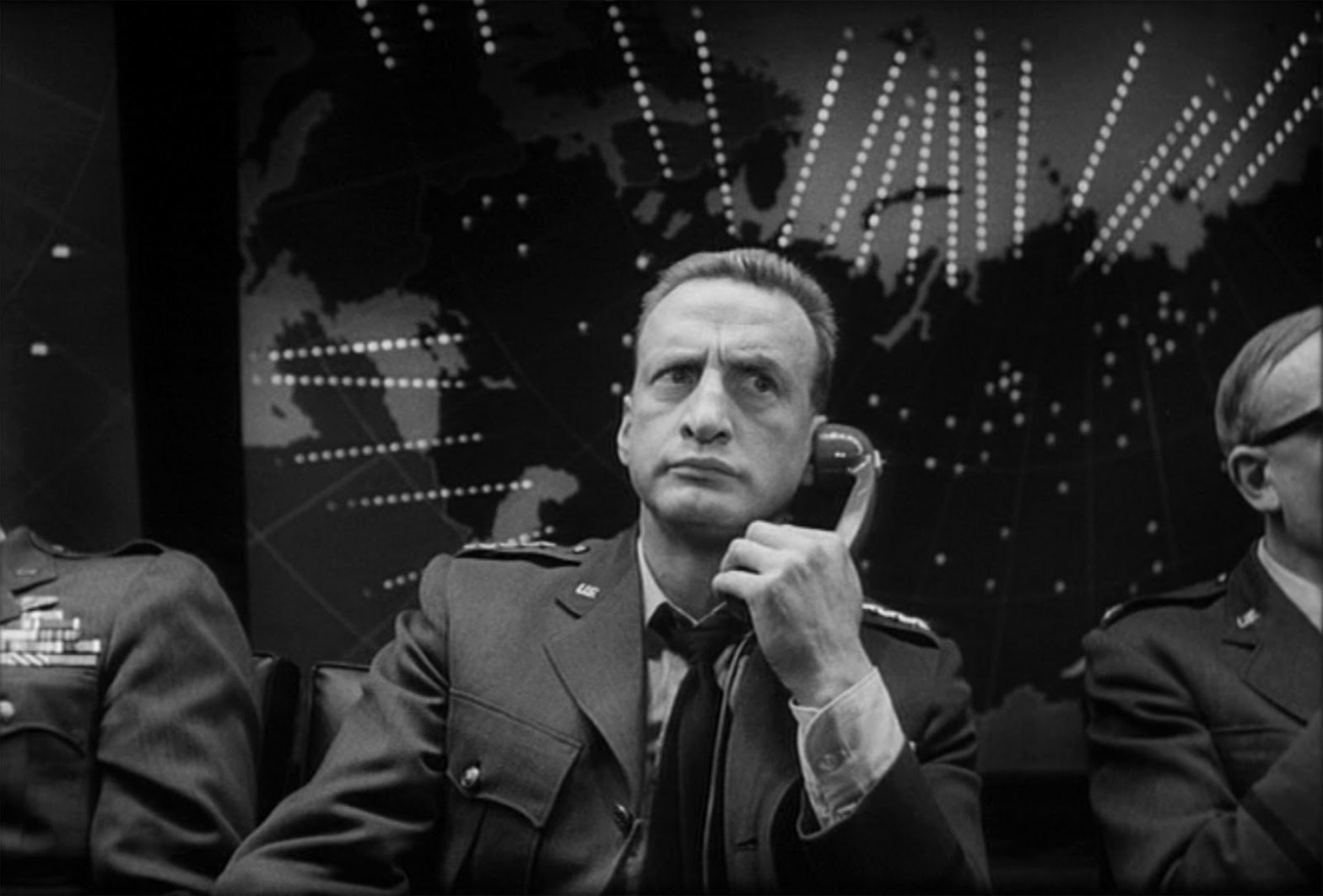
Once that happens, everyone in the war room realizes they’re completely fucked, but Dr. Strangelove is like, ‘hey, why don’t we set up a little society in our really deep mine shafts and ride out the nuclear winter?’ and they’re all like, ‘yeah, that sounds okay, especially cause we’ll have to bring a whole bunch of women to repopulate the Earth.’ Of course Strangelove throws in his eugenicist ideas into the equation, that the women should be selected for certain qualities. Then Turgidson, even in the face of 99.999% of humans about to be killed, still is talking about the fucking Cold War! He’s still a war hawk, talking about a ‘mine shaft gap.’ I guess that’s kind of the main point of the movie, the lunacy of the Cold War. Even the Russian ambassador secretly takes a picture of the big board. Then we get a beautiful montage of nuclear blasts, set to Vera Lynn’s We’ll Meet Again

It’s one of the best movies ever made, in my opinion. To me, it has the same vibe as a Kurt Vonnegut novel. If Vonnegut was a filmmaker, I think he’d make a movie like this. But he wasn’t, and Kubrick made this movie. It’s funny, it’s dark, it’s a brutally cutting satire. I love it. But I will say this: I did not learn to stop worrying.

The Difficulty in Dealing with Declining Depression

Depression itself is difficult, obviously. It’s just really bad. It is a serious ailment that prevents [or seriously impedes] the ability to apply treatment to the ailment itself. Imagine if you had a cold, and the cold prevented you from taking vitamin C. What if you had an infection, and the infection prevented you from taking antibiotics? That’s [partly] what depression does. There are some things that [can] alleviate [some of] the effects of depression. Regular exercise, healthy diet, and spending time outside can help. And what does depression prevent you from doing? Exercise, eating right, and going outside. It’s fucked!

And I know these things aren’t “cures,” and I’m not saying, “Depressed? Just go exercise bro. HA!” So shut the fuck up before commenting that.

Anyway, depression is fucked. It’s horrible, and there are a lot of other shitty aspects to it that I haven’t mentioned here. They’re well documented. What I really want to write about is this unexpected difficulty that I’ve experienced during a period of relatively declining depression. Wow, kinda convoluted wording there, sorry about that. How about this: I was very depressed, recently I’ve been doing a lot better, but I’ve met some difficulties in this transition that I didn’t expect. 

I’ve had a few periods of fairly severe depression, one of which almost resulted in my death. There were periods in which I was doing pretty well, and then the depression would come back. There were ups and downs, peaks and valleys, the great rollercoaster of life. Quite poetic, as all life should be. And it was rollercoaster-esque. Lots of ups and downs quite quickly. But the last few years I’ve been on a “long haul to recovery,” as I call it. It’s more of a slow and steady increase in well-being. There are still setbacks, obviously, but it’s not as extreme. There has been an overall positive trendline. Maybe not a “line” in a “y=mx+b” sense of the word. Maybe more of a logarithmic function.

What I’m trying to say is that there’s been a steady decline in depression in my life. That’s great! It’s cause for celebration! I’m happy about it. There has been an unexpected struggle with it, though. So before my first serious period of depression, I had a certain identity, a certain idea of myself. It was based on my behavior, what I liked to do, what others liked about me, what others said about me, what I thought of myself, things I valued, my experiences, my strengths and weaknesses, etc. That’s who I was, or at least who I was in my own narrative version of myself. 

And who was that guy? Well, I thought of myself as a whimsical, clever, witty young man. Kind of a “fun and fancy free” type of fellow. I liked to say jokes and think interesting thoughts. I was curious, and I wanted to increase the amount of fun in the world. I liked to put interesting, fun, strange things out there, trying to make the world a more interesting place for whoever met me. You know, kind of a whimsical shithead. It was great.

Then the depression hit, and it seemed to create this cursed version of myself. I couldn’t be how I was. Sometimes I didn’t even want to do the things I used to enjoy. I wasn’t really contributing anything positive, I felt, and of course I was aware of all of this, this degraded version of myself, and that made me feel even worse, and I spiraled down. Very bad. Bad! But now I’m doing pretty well. I’m excited. I’m thinking, “Finally! That cursed version of me is so insignificant now. I gotta get back to my true self!” I’ve had this desire to recapture my old, whimsical self for this new era. I’ve been trying to get back to the “real me,” but it doesn’t really work that way. I can’t actually do that. I’m trying to do the things I loved to do before, and act the way I did back then [or close to it], but it doesn’t really work the same way. I’m not the same. Some of the old stuff is great, some of the whimsical stuff, but not all of it, and it’s not the same. 

It’s tough, because there’s the old, whimsical me, the cursed/depressed me, and now there’s me. There’s a bit of both in the current me. Who knows, maybe I’m just trying to rewrite the Ship of Theseus. Oh! Or maybe all the parts of me, the whimsical, the cursed, and all the parts of those parts, have been strewn about, and my task now is to take the parts and forge them into something better, something stronger, like… I don’t know, what was Aragorn’s sword’s name in the Lord of the Rings? Bit odd that swords have names. You’d think they would just call it “Aragorn’s sword,” or I guess “Isildur’s sword” at the time. If I had a sword, it’d be called “Lefty Forrester’s Sword.” I guess we have done something comparable in modern times with “Fat Man” and “Little Boy.” 

Anyway, this new chapter of my life, though the depression is improving a lot, has still been difficult. It’s hard to find, maintain, and move forward with your identity after such a long period of battling with depression. Now, even though this is a difficult thing, I would in no way claim that it’s more difficult than actually dealing with the actual depression. Depression is monstrous, and it can devour you. I guess what I’m trying to say is that, even if you’re not really experiencing the depression directly any more, it can have lingering effects on yourself and your identity. It’s tough, but I’m here for you! Let me know how it’s going!

Clay Higgins

Today I’d like to write about a tweet from a Republican United States congressman, Clay Higgins of Louisiana. The tweet, posted on February 27th, 2022, reads as follows: “You millennial leftists who never lived one day under nuclear threat can now reflect upon your woke sky. You made quite a non-binary fuss to save the world from intercontinental ballistic tweets.”

Now, I don’t have a Twitter account any more, but I saw this tweet as a screenshot on some other sites. I was immediately intrigued by it because I couldn’t quite understand what it was saying. I kind of understand the words being used, but it doesn’t seem to make sense. I’m not sure what, if any, the point of these two sentences actually is. There’s just kind of a vibe that millennials are bad. But let’s try to make sense of it.

So, he starts off with “You millennial leftists,” and that’s me! That’s what I am! Of course, Republicans use the word ‘leftist’ all the time just because it’s very spooky, but a lot of the time they’re just talking about liberals, who are not leftists. He’s probably just lumping everyone together, as people do. I’ve also heard the term ‘millennial’ being used in a derogatory tone for basically my entire life. Not derogatory like a slur, but just said with disdain, in an obviously negative tone. It’s only during the last couple of years that the reverse has happened, with ‘boomer’ being commonly said in a derogatory tone. 

I’m not really a fan of either because I don’t think it’s all that funny, to be honest. Kinda lazy. It’s just like, I’ve heard so many times people just kinda be like ‘Oh! Millennials sure do stuff…’ and that’s like the whole joke. The word is just said, and if you already don’t like millennials, it’s funny to you.

Anyway, he’s addressing millennial leftists, and he’s claiming that we’ve never lived under a nuclear threat. That’s at least an interesting claim. What counts as a nuclear threat? Since 1949, there have been at least two nations with functioning nuclear weapons. Have we been all living under a nuclear threat since then? Since there has been a possibility of nuclear war since then? That is my opinion. Every single day of the last 70ish years, there could have been a nuclear strike, and every single day we haven’t had it yet.

But maybe that’s too lenient of a definition. That doesn’t constitute a nuclear threat. In order for a period to be considered a nuclear threat, a threshold of probability has to be crossed. And nuclear war isn’t just gonna happen out of nowhere on any random day. There would have to be an escalation of tensions, wars, etc. before it went nuclear. My response to that is: is that a law of the universe? 

And what is the threshold, then? One event that we can all agree upon as being a nuclear threat was the Cuban Missile Crisis, which occurred in 1962, when Clay Higgins was one year old. I can just imagine a really old guy talking shit on Higgins for not being self-aware during a real nuclear threat. That’s why Higgins is such a piece of shit, because he wasn’t a big boy when WWIII was closest to happening.

This has to be the purpose and meaning of the tweet, that I’m somehow a piece of shit for not having lived under a sufficient nuclear threat for Higgins’ liking. Like, how the fuck am I supposed to control that? Isn’t it good to not live under nuclear threat? Isn’t that one of the minor successes of the conclusion of the Cuban Missile Crisis? That people could breathe a bit more easily moving forward? 

And he says that millennial leftists “can now reflect upon your woke sky.” I really don’t understand what he’s trying to communicate here. What is a woke sky? Woke is another one of those words that Republicans just throw around. They’re just like, “AAghh! There is something woke happening here! That’s bad! Someone’s committing a woke act against me!” Again, if you already hate “wokeness,” or whatever you believe to be “woke,” then when you see the word being used in a derogatory way, you’ll be like “Hell yeah!” even if nothing is being said.

It seems like Higgins is trying to form a “you reap what you sow” type of statement. Like, you millennials sure fucked around by not living under a direct nuclear threat, and now you’re paying the price. The price is that you have to reflect upon a woke sky, which is a real, legitimate thing. I’d be curious to hear him expand on the meaning of “woke sky.” In what way is the sky woke? 

His second sentence is even less coherent. “You made quite a non-binary fuss,” what could that possibly mean? Making a fuss in a non-binary way? Or the fuss itself is non-binary? I guess he’s trying to make some vague point about gender. Millennials [I think] are more generally more accepting of different gender identities and expressions and things like that than older people, like Higgins. So he thinks that everything we do is about gender? I’m confused about this. I know a couple non-binary people, and sometimes they make a fuss about something, like their job. That has nothing to do with being non-binary. It’s not a “non-binary fuss.” If, let’s say, Millennial leftists were against a Russian invasion of Ukraine, and we wanted it to not turn into a nuclear war, would that have anything to do with people being non-binary? Conversely, does the Russian invasion of Ukraine have anything whatsoever to do with non-binary people getting more recognition and acceptance? As if Putin was sitting there like, “Man, I’d really like to invade Ukraine, but U.S. millennials are just too binary for me to do that. Oh wait, they made a non-binary fuss? Time to invade Ukraine and threaten nuclear war!”

Now, Higgins’ tweet did not mention Russia or Ukraine specifically, but it was tweeted while Russia was invading, and while Putin was posturing about his nuclear arsenal, the greatest in the world [I think]. So it’s hard to believe that his tweet, which references nuclear threats, has nothing to do with the current war. 

Okay, so what is the non-binary fuss even about, according to Higgins? To prevent “intercontinental ballistic tweets,” a surreal combination of words. Another reference to nuclear war, it seems, as intercontinental ballistic missiles [ICBM’s] would potentially be used to deliver nuclear weapons to their targets over long distances. That’s part of what makes the potential nuclear war so scary, is that these things travel very far, very fast. But he’s not talking about missiles. He’s talking about ballistic tweets, which, again, are real. Woke skies, non-binary fusses, and ballistic tweets are all real things. 

Anyway, I suppose this is some attempt at referencing conservatives who have been banned from twitter, most prominently Donald Trump. I’m not sure if he’s making the claim that millennial leftists view tweets as comparable to ICBM’s. I’d be surprised if any millennial leftists actually thought that. “Intercontinental ballistic tweets” kinda reminds me of those old Looney Tunes where Daffy Duck would send a big missile at Marvin the Martian. Then the tip of the missile would open up and it would just release a little message saying “Bang!” or “Ouch!” or something like that. Just imagine Putin writing a tweet, and when he hits “send” it launches an intercontinental missile, and it travels all the way to Washington D.C., and then it just stops and a little flag comes out, and it says “Welcome to Cold War 2.0,” that’s a ICBT right there.

So, if I was forced to try to interpret Higgins’ tweet as a whole, I would say that these are his main points: Millennial leftists [spooky] have not lived under an intense nuclear threat, and that is a bad thing. It has led to two distinct negative outcomes: the development of a woke [spooky] sky, and the creation of non-binary [spooky] fusses. Those two negative outcomes combine in a futile attempt to prevent tweets, which resemble nuclear missiles somehow. 

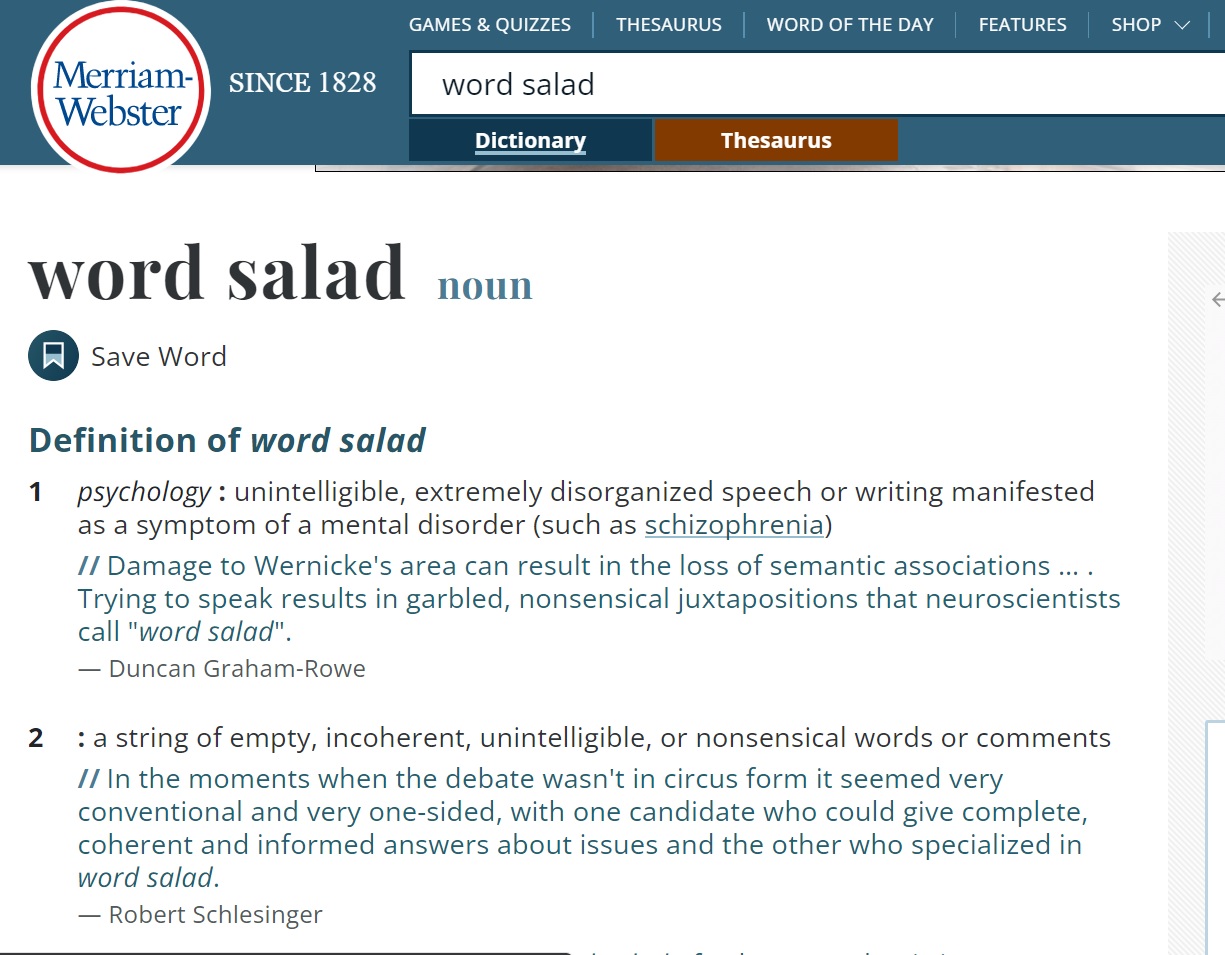
In reality, it’s just a word salad that makes no sense. It’s just an angry guy throwing a bunch of words that he hates into a couple sentences that have no meaning. It’s almost like that sentence, “More people have been to Berlin than I have.” Each word seems to combine with the previous word, but as a whole, it’s meaningless. 

Just for fun, I’ll make up my own tweet, in a similar fashion, against people like Clay Higgins. Here it goes: “Boomer conservatives, who never lived in fear of school shootings, can now consider their politically incorrect roadways. You made quite a 2nd amendment tantrum to change the world with high-capacity minion memes.”

Men Are from Earth, Women Are from Earth

Once upon a time, a young man planned a beautiful date for his girlfriend. He laid out a white blanket, with flower petals, and champagne, and little bullshit sandwiches, and cheese, and stuff. It was a romantic picnic in a park, overlooking some city’s skyline. It was a thoughtful, wonderful gesture, a lovely date. The girlfriend in question took a picture of the picnic spread. She posted the picture online with a short message expressing her gratitude. She felt lucky to have such a boyfriend. 

Another young woman, a complete stranger to the girlfriend in question, took a screenshot of the post. She re-posted the image with her own original comment above it. The comment was: “Are there still guys that do this type of thing???” The funny thing, of course, is that she asked this on a picture of a guy doing the exact thing she’s asking about. The evidence is right there. 

Now, because this post (the re-post, with the question) was on a social media platform, there were a number of comments attached to it. Many of the comments were made by young men, saying things like “women don’t appreciate this type of thing any more.” Again, they’re claiming that on a post of a woman appreciating the very thing they’re complaining about! The evidence is right there. 

Why do we do this? The short answer is that we’re frustrated and we’re trying to vent. It happens. There is a tendency for us to extrapolate in this exact type of situation. The human brain notices patterns. It likes patterns. It catalogues data, based on experience, and uses that data to understand the world. It recognizes cause and effect. When I did X, Y happened. When I did X 10 times, Y happened 9 times. So X leads to Y. There is a tendency to apply this line of thinking to our personal relationships as well. We extrapolate. 

We can’t help it, really, but it’s best to minimize the effects of this extrapolation. Or, to be more precise, it’s best to minimize the negative effects of this extrapolation. A lot of the time it’s bad, but sometimes it’s good. For example, if you mock other people’s appearances, and they dislike you for it, it’s probably good to extrapolate that people generally don’t like to be mocked for their physical appearance, so stop doing it.

In the romantic relationship sense, we do a great deal of extrapolation that is harmful. We allow other peoples’ rejections of us dictate our future behavior, mindset, and actions. Let’s re-examine the initial example. Some of the men who commented on the re-post, saying that women don’t appreciate those gestures any more, many of them may have experienced that. They really liked a woman, and wanted to show that, so they tried to do a grand, beautiful, romantic thing for her. And it failed. They were rejected, or the woman didn’t like it, or they eventually broke up and she went with someone who doesn’t do that sort of thing. It just doesn’t work out. 

So the man extrapolates that, well, women just don’t like that. So he stops doing it. But the next woman might really like that type of thing! So the man is changing his behavior and who he is based on very incomplete data. The truth is that there are billions of people, and they’re all different, and they all want different things in a romantic relationship [some don’t want one at all]. The extrapolation doesn’t make a whole lot of sense, but we [including me] still do it.

You could be a really funny person. That’s a core part of who you are. You make people laugh, including the people that you have romantic feelings for. So you’re making people laugh all the time, but you keep getting rejected or ghosted or broken up with or whatever. It’s tempting to think, “Look, making people laugh is fun, but it doesn’t work in attracting a partner, so I’m gonna stop trying.” And that’s really fuckin tragic, when someone gives up a significant part of themselves because it didn’t appeal to someone that they really cared about. It happens with a lot of things. “I wrote a song for someone, but it didn’t move them in the way that I had hoped, so I’m gonna quit writing songs.”

That dejected feeling is awful, but that’s part of vulnerability. That’s part of putting yourself out there. You’re subject to some disappointments. Some really bad disappointments. 

And the harsher truth is this: giving your all for someone you love is not inherently more valuable to them than another person giving them what they want. If you really love someone, you might give all your time, energy, effort, and all the love you have to that person. That’s great, but someone else can come along and just provide the person you love with what they want. And that’s it, they choose someone else over you. That’s just the way it goes sometimes. You just gotta keep going. Don’t extrapolate too much, and keep being the best you can be.

Sports Team Politics

A lot of words have been strewn about in order to describe, diagnose, and cure sports team politics in the United States. If you haven’t read or heard these words, let me summarize: sports fans root for their favorite team no matter what. This leads to contradictory, inconsistent viewpoints and opinions. All you want is for “your team” to win. For example, I am a fan of the Los Angeles Lakers, and I hate the Boston Celtics. When point guard Rajon Rondo played for the Celtics, I thought he was an annoying, dishonest player. Once he played for the Lakers, I thought he was a crafty, intelligent player.

In U.S. politics, there are two main teams, the Democrats and the Republicans. A great many people identify strongly with one team at the complete exclusion of the other team. They root for their political team in a similar way to a sports fan rooting for their sports team. They ignore their own team’s faults, or recategorize them as strengths, and they focus on the other team’s flaws. They root for their team to win more than they care about their team doing a good job or society actually improving. 

Now, this phenomenon has been explained by a lot of people in the so-called “center.” They claim that, “Oh, both Republicans and Democrats engage in sports team politics [which is true], and I, the centrist, rise above that, developing a better view.” That’s certainly a popular point of view, and I’d prefer that to the sports team method. It’s more honest, but it often leads to the centrist falsely believing that they don’t have their own biases, which they of course do. But I want to make clear that this is not my point of view. I am critical of both sports team politics and the centrists from the point of view of the left. To the left of the so-called “left” team. I’m a Lefty [it’s in my name].

Anyway, there is one element of sports team politics that I find particularly interesting. It is a very, very strange style of rhetoric. I’ll explain by example. There is a history teacher named Mr. Beat who has a YouTube channel. He mostly discusses American history. One of his videos featured him watching and responding to PragerU videos for seven hours. PragerU is a conservative channel, very much on the Republican team. Mr. Beat watched a PragerU video about Richard Nixon. The video essentially said that, while Watergate was bad, Nixon did a bunch of good things, and the scandal overshadows his achievements. 

One of the things that PragerU includes as a positive for Nixon’s legacy is his environmental policy. He built up the EPA, and he passed environmental regulations. Now, if you know anything about PragerU, you know that they despise environmentalism and environmental regulations. In fact, the very next video that Mr. Beat watched was about the so-called “War on Cars,” and how environmental regulations are bad. So, do you like environmental regulations or not?

It’s a peculiar thing because they’re essentially defending their team member from the point of view of the other team. Odd! “Hey liberals, you shouldn’t criticize Nixon as much because he made environmental regulations, which we hate. But we won’t criticize him for that!” What the fuck? I find this strategy to be particularly interesting because most sports team politics involves a simple uncritical view of your own side combined with a thoughtless hatred of the other side. But this example is different in that it is an explicit advocation of your team by the values of the other team.

Of course, the other funny thing about sports team politics is when fans venerate their old team members, completely ignoring the team’s shifting ideology over time. Abraham Lincoln is a fun example of that. And the Civil War in general. As former President Trump said, “If you go back to the Civil War, it was the Republicans that really did the thing.” He also talked about how “people never give us [the Republican Party] credit for this, Abraham Lincoln was a Republican, right?” 

That is so emblematic of the comparison to sports teams. Like I said, I’m a Lakers fan and I hate the Celtics. I wasn’t alive for the 1980s or 1960s versions of the rivalry. HOWEVER! I still praise the old Lakers and criticize the old Celtics. Cause that’s my team! I’m just gonna be biased towards my team because it’s fun. It’s not particularly serious. It’s funny when Republicans latch onto Lincoln while simultaneously praising his greatest enemies, the Confederacy. I wonder if they’d be more supportive of removing Confederate statues if we called them “Democrat Statues.” 

Those are most of my thoughts on the matter, and of course it’s not just Republicans and conservatives; Democrats and liberals engage in sports team politics as well. This, perhaps, is even more damaging because it enforces this warped version of “the Left,” where the Democratic party is mostly a corporatist, imperialist party who are just a bit nicer to gay people. More to say on that later!

Top 5 Greatest NBA Players Named Kevin

In honor of the 75th anniversary of the NBA, I thought I’d take some time and write about some of the greatest Kevin’s to ever do it. We’ve probably all known a Kevin or two in our lifetimes. I know I have. 

Kevin Love

Kevin Love was selected fifth overall in the 2008 NBA draft. He was traded on draft day from the Memphis Grizzlies to the Minnesota Timberwolves [There’s a lotta Timberwolves-related stuff on this list, weirdly]. In 2011, he became the first Timberwolves player to become an all star in the post-Garnett era [Hey, another Timberwolves player named Kevin!]. He also led the entire NBA in rebounds per game that year. 

That was his game, rebounding, but he also developed into a pretty decent, well-rounded scorer too. He shot pretty well for a big guy, though nowadays most big guys can shoot threes. But back in 2012 it wasn’t as common, but it was still more common then than in the 1980s. [I used “then” and “than” one right after the other, that’s a bit weird].

Anyway, Love’s best season was probably 2014 when he averaged 26.1 PPG and 12.5 RPG, among other fascinating stats available at basketball-reference.com. He was one of the premier young players, so it was really exciting when he was traded to the Cleveland Cavaliers, joining the world’s greatest player, Lebron James, and another all-star, Kyrie Irving. 

And, you know, Kevin Love was still pretty good, but it didn’t pan out as well as I had hoped. Obviously there was some bad luck with injuries in 2015, then running into the Kevin Durant [Hey, another Kevin!] version of the Warriors, which were essentially unbeatable, then they lost Irving. Even with all that, I would say that Love never truly lived up to expectations in Cleveland. Maybe his stats and production were a bit inflated in Minnesota by playing for a bad team. 

I’m not trying to say that he isn’t good. He’s obviously good, but it seemed to me in 2012ish time that he was gonna be the next GREAT power forward, but he was just a good player. And… yeah, he was good. Great rebounder, good scorer, good player.

Oh yeah, and his uncle Mike Love was in the Beach Boys, so that’s pretty cool. When the Cavs won the championship in 2016, I really wanted them to make some funny reference to the Beach Boys connection, like a parody song or something. It could’ve been hilarious, but Lebron hasn’t really done much funny like that since 2010 for some reason. Maybe his life changed a lot that year.

Kevin Johnson

Kevin Johnson was drafted seventh overall in the 1987 NBA draft by the Cleveland Cavaliers. He was traded in his rookie season to the Phoenix Suns, where he spent the rest of his playing career. By just his second season, he was already one of the best point guards in the league, earning all-NBA second team honors, alongside John Stockton [some guys named Jordan and Johnson were the first team guards]. He also won the Most Improved Player award, which is a pretty interesting award, if you ask me.

He was a super quick, super athletic point guard, which was more rare back in the 90s compared to now. Kevin Johnson had some pretty ferocious dunks, including one amazing dunk on Hakeem Olajuwon [a pretty good player/defender and much taller than KJ]. In that breakout second season, he averaged 20.4 points and 12.2 assists per game. Pretty great, considering the only other players to average 20 PPG and 12 APG in a season are Magic Johnson and Isiah Thomas. [source: Jonny Arnett (a good NBA youtuber, check him out)].

Anyway, Kevin Johnson was a big part of the 1993 Suns, who made the NBA Finals, though he did have kind of an off year, missing a lot of games, and a so-so finals performance. He peaked kind of early, but I think he’s one of the more underrated players in NBA history, since he gets overshadowed by other 90s point guards like John Stockton and Gary Payton. Go watch some Kevin Johnson highlights, you’ll be impressed.

Oh yeah, and he became the first African-American mayor of Sacramento, which is pretty cool. I don’t know how good of a mayor he was, but his mayoral record did not factor into these rankings anyway. Here’s another interesting thing: the 1996-97 Phoenix Suns featured playing time from Kevin Johnson, Jason Kidd, Sam Cassell and Steve Nash! That’s four point guards who were all-stars at some point in their careers, and two point guards that are now in the hall of fame.

Kevin McHale

Kevin McHale was drafted third overall in the 1980 NBA draft by the Boston Celtics. The Celtics actually had the the #1 pick, but they traded it to Golden State for the third pick. Within that trade, the Celtics also acquired hall of fame center Robert Parish. Thus, the greatest frontcourt in NBA history was assembled [they also had Larry Bird, a pretty good player].

The Celtics actually won the NBA championship in McHale’s first year, but he wasn’t a key contributor just yet. He was only a rookie after all! He improved steadily over the next few years, becoming an all-star and earning All-NBA First Team honors in 1987.

The most famous play in McHale’s career was a dirty foul against Kurt Rambis in the 1984 NBA Finals. He grabbed Rambis by the neck while he was in the air and pulled him down. What a unique defensive strategy! Cool gameplay!

Anyway, McHale had a pretty incredible post game, which was nicknamed the “torture chamber.” Kind of a weird name, but he was amazing in the post. He’d throw out a ton of moves and fakes, and his ridiculously long arms allowed him to toss up shots above basically anyone. He was the second best player on the Celtics in the 1980s, and if you know anything about the Celtics in the 1980s, you’ll know that they were pretty darn good. They won three championships, made five finals appearances, and McHale won 6th man of the year twice in a row. He was one of those guys, like Manu Ginobili, that was kinda “too good” to come off the bench, but did anyway. Of course, McHale did eventually start at power forward.

One of the greatest players of the 80s, the second-best on the legendary 86 Celtics, one of the greatest players of all time

Kevin Garnett

Kevin Garnett was drafted straight out of high school in 1995, which effectively launched the straight-outta-high-school era of the NBA draft. In the ten years that followed the following notable stars would be drafted directly from high school: Kobe Bryant, Tracy McGrady, Amare Stoudemire, Lebron James, and Dwight Howard, among several other players who made at least one all-star team. Before Garnett, it was extremely rare for players to get picked without going to college, and after him came a flood of high school seniors jumping to the pro’s.

Garnett was part of a great generation of power forwards that emerged towards the end of Barkley’s and Malone’s careers. We’re talking about Duncan, Nowitzki, Webber, and Rasheed Wallace. And I know that Duncan is always considered to be the greatest power forward of all time with the best career, and I agree. BUT, Garnett at his best [2004] was about just as good as Duncan at his best [2003, maybe]. They were both amazing, of course.

The problem was that Garnett was drafted to the Minnesota Timberwolves, who are generally not good, to say the least. In fact, I know there used to be a stat where Tim Duncan as a player had more wins than the Timberwolves as a franchise. I don’t know if that’s true any more.

Garnett was a tenacious defender and rebounder, and a well-rounded offensive threat. In the 02-03 season, he led his team in PPG, RPG, APG, BPG, and SPG, which demonstrates his incredible ability mixed with a supporting cast that was unable to help Garnett to the finals. The T-Wolves made the conference finals in 2004, but lost to the Lakers. After a few downward years for the team, Garnett was traded by, funnily enough, Kevin McHale. The trade sent Garnett, funnily enough, to McHale’s former team, the Boston Celtics. It was agreed upon, funnily enough, by McHale and his former teammate, Danny Ainge.

Anyway, that first year, the Celtics improved by 42 wins, and ultimately won the NBA championship over my beloved Lakers, culminating in a brutal 39-point victory in game 6 to clinch the series. Still the worst game I’ve ever watched as a Lakers fan. He then shouted “Anything is possible!” which was pretty cool. Oh, and Garnett won defensive player of the year in 2008 as well. Only five players have done that [Michael Jordan, David Robinson, Hakeem Olajuwon, and Giannis Antetokounmpo being the others]. Pretty good company.

Garnett was one of the greatest defenders in NBA history, and his intensity of play is on par with guys like Michael Jordan and Kobe Bryant. I actually love Garnett as a player, even though he was on the hated [by me] Celtics. But when he was on the Timberwolves, he was one of my favorites, and well-deserving as the 2nd greatest Kevin in NBA history.

Kevin Durant

Kevin Durant was famously drafted second overall by the Seattle Supersonics in the 2007 NBA draft. Famous because Portland passed on Durant in favor of Greg Oden. Durant would go on to become the greatest Kevin in NBA history, and Oden isn’t even in the top 10 Greg’s. It was the second time that Portland had passed on one of the greatest players of all time. The first instance, obviously, was when they passed on Michael Jordan in 1984. Literally 1984. Orwell’s nightmare became reality.

In 2010, Durant became the youngest player to win the NBA scoring title, a feat he accomplished over the likes of Lebron James, Carmelo Anthony, Kobe Bryant, and Dwyane Wade. Pretty good players back then. He’s won the scoring title four times, and he’s currently leading the NBA in PPG this year. Only Michael Jordan and Wilt Chamberlain have more scoring titles than him. Those are pretty good players too.

The point is that Kevin Durant is a basketball scoring machine. He’s tall with long arms, and he shoots with a high release, making his jumpshot nigh unblockable [is that how you use the word “nigh”?]. He can shoot from basically anywhere, he’s got handles to get to the basket, or wherever he wants to go. He can make free throws, midrange, threes, anything. Plenty of people call him the greatest scorer in NBA history. I don’t, but plenty of people do, for whatever that’s worth.

He won the league MVP in 2014, but then he said his mom was the real MVP, which was nice. Now, we all know that in 2016 the Thunder lost the Western Conference Finals against the Warriors after leading 3-1. Durant did play pretty amazing in games 5 and 7, though. Here’s the other thing: they beat a 67-15 Spurs team right before that. That Spurs team had one of the best regular seasons of all time. They were incredible. It was a crazy postseason. 

Then Durant left the Thunder during the next offseason and signed with the Warriors. They won the next two championships and Durant won the two Finals MVP’s. He missed the first four games of the 2019 Finals, then tore his achilles in game five. Now, some people seem to think that Kevin Durant’s free agency decisions somehow make him less good at basketball. How does that work? Did he get worse at shooting, dribbling, defense? No. Sure, his efficiency was boosted by being surrounded by GOAT shooters, but he didn’t get worse. You might not like him, and that’s fine. There’s no rule saying you have to like the best player. The best Kevin in NBA history.

Dead Man Knocking

Hello! 

I am proud to announce that my first work of fiction is now complete and available for purchase! Hooray! It’s called Dead Man Knocking, which is a serious, serious title. It’s about death, and men, and knocking on things. Serious, serious stuff. No, it’s about a skeleton who tries to write knock-knock jokes. No! It’s seriously seriously about a young man coming to terms with his place in our modern world with its changing climate. Kinda like what we’re all doing right now.

I worked hard on this one, sitting at my typewriter going clickity-clackity-click. I shuffled through my papers, flipping through them, re-reading them, making notes and crossing things out, all while sipping a glass of whiskey like some weird Hemingway-wannabe. Of course, as is the case with everyone in our society, I am a slave to computers. So I took my papers and typed away with a softer version of the clickity-clackity-click. And I continued to edit, and now it is complete.

Quite a few people purchased my last book, which was a collection of “lessons” [check it out on my page], and I greatly appreciate that. It made me feel good, it boosted my confidence, and it helped financially. I mean, every bit helps, and I am trying to save some money for an abroad program that I will be doing. So, for all those reasons, thank you very much. And I would be even more appreciative if you found it in your beautiful heart to purchase this first novel of mine.

Now, you’ll see that the book has a very simple cover. It’s got the name of the book on it,  it’s got my name on it, and it has some red hands on it. That’s pretty ominous, isn’t it? Those hands probably represent something, don’t they? I’m curious about that. And on the back there is some sort of attempt at humor. But we all learned and believe that you should not judge a book by its cover. So stop doing that! I need to stop doing it too! Judge a book by, I don’t know, the power of its words, or something. 

Anyway, I think you’d like the book, and I think you should buy it, and read it. How does that sound? Pretty good, I’d say. Maybe you got an Amazon gift card for Christmas from your crazy uncle. That uncle that lives somewhere in the middle of rural Oregon, that you haven’t seen in a long time, but he still sends you a birthday card and a Christmas gift every year, but he doesn’t really know you, so he just sends money and gift cards. That uncle? 

So you might be thinking, “Gee, I sure do appreciate this Amazon gift card, but what should I buy with it?” Maybe you should support an up-and-coming author as he begins his meteoric rise. That sounds like an interesting plan. Do that. Thank you.

Oh yeah, you can find it here: https://www.amazon.com/Dead-Knocking-Lorcan-Lefty-Forrester/dp/B09K1TXHQ6/ref=sr_1_1?crid=1HBPXKIX3A1Q5&keywords=lefty+forrester&qid=1640983769&sprefix=lefty+forreste%2Caps%2C167&sr=8-1

Motivation

I recently attempted to complete a writing challenge called NaNoWriMo, which stands for the National Novel Writing Month. Essentially, it is a challenge to write a 50,000 word novel in the month of November. I did not complete my novel in time, but I am very proud of the incredible progress I made, especially considering the fact that I’m a full-time college student and I work 30 hours per week at my job. And I’m gonna continue it and finish it.

November was one of the most motivated months I’ve had in a long time. I was writing a lot, reading a lot, doing well in my classes, working my job, exercising a lot, eating pretty well, and I didn’t drink until the last day of the month. So it got me thinking about the concept of motivation, what it is, what it isn’t, how it feels, and so on.

Sometimes I feel a feeling of motivation, and sometimes I don’t. Some days I wake up and I’m just like, “Yeah! Let’s do it! Let’s do some stuff! I’m motivated!” and it honestly can feel very euphoric. I feel like a hero. Especially when it’s that super-motivation feeling in a creative sense. When I’m motivated to write, and the writing is flowing freely, and it’s good [hopefully], and I’m getting a lot done, that is one of the best feelings in the world. I start thinking, “Yeah! This is amazing! This is why I’m here on this planet!”

Bit of a cheesy thing to think, but you are what you eat. Anyway, motivation is kinda like… happiness, or something. You can’t really force it to happen. There’s no magic formula to produce it. Sometimes you just don’t have it. Like two weeks ago, I was planning on writing this essay on Christmas movies. I had some interesting thoughts, some funny jokes, some social commentary. It was gonna be great. But it was getting close to Christmas. So on the 23rd I was like “All right, I’m gonna go to work, get through the day, drink coffee so that I have enough energy. Then I’ll write that essay when I get home.” 

Then I got home, and I started writing about how, in the old Rudolph movie, Rudolph goes through puberty, and when he reunites with the reindeer who bullied him, they all have New York accents for some reason. That’s kind of interesting, but after I wrote a little bit, I just felt no motivation. I did some pushups. That helps sometimes, but not this time. There’s no magic formula. It was just done. So I closed my computer. Bit sad, innit?

And yeah, sure, there are things you can do to make the feeling of motivation more frequent and more likely. Sure. For example, if you drink a lot of alcohol, you probably won’t have a strong sense of motivation the next day. And living a healthy lifestyle in general will, generally, lead to more motivation, generally speaking, of course. That’s how it was for me in November. I was exercising a lot, eating pretty well, I wasn’t drinking, I was going to sleep early and waking up at the same time, that type of thing. But here’s the problem: those things also require motivation! That lifestyle may produce some motivation for writing, but it also requires motivation to exercise every day. It’s fucked! 

So inevitably there comes a day when you can’t summon the energy to do those things, those things that are sustaining your motivation. You just can’t do it one day. That’s all right, you take a break. You try to recapture the motivation the next day. There’s some, but not as much as before. And then, well, it snowballs. It can snowball, until you’re an unmotivated blob, eating Chex Mix and replaying Super Mario 64 for the hundredth time. That’s what I do anyway. Sometimes, tragically, I seem to reach a low point of despair before I’m jolted back into a motivation-fueled period. Bit tough, innit?

So that’s the day-to-day motivation. But what about the general motivation of one’s life? What motivates me the most in life? That’s a huge fuckin question, and one that people may grapple with throughout their entire lives. I know I do, from time to time. Is it money? Love? Fame? Literary excellence? Something as indescribable as success? The approval of certain people? What motivates me? A combination of things. The mind is a complex thing, and it has a convoluted set of wrinkles and billions of neurons which shoot certain messages here and there. I’m not too sure. 

I think about it often. What motivates people? Different things, probably. They’ve all got their own billions of neurons firing their little electric signals about. Some people say, “Well, people everywhere and in every culture are just motivated by profit. Money. Greed is everything in human nature. That is the motivation.” I find that very interesting. I disagree, of course. I think we can look at people and see that they are trying to make more money, they want more money, they’re happy to make more money. One person can see that and say “people are motivated by greed.” Meanwhile I can see those same people and say “people are motivated by a desire to improve their lives, and the society is designed such that the best way to improve your life is through money.” 

Martin Shkreli certainly is motivated by profit, by money, by greed. He’s a lot more motivated by that than, say, Jonas Salk. Of course, Salk needed money to live, as we all do. 

I find this reduction of human behavior to greed quite peculiar. I’ve heard it my whole life, and I’ve believed it at times. I don’t now. I find it especially interesting when discussing an idea such as Universal Basic Income [UBI]. Sometimes the same people who say that people are fundamentally, completely motivated by maximizing their own wealth, will also say that, if we give people enough to live, they’ll simply collapse and do nothing for the rest of their lives. If greed was such a fundamental motivating factor of human nature, why would it disappear once basic needs are met? Bit strange, innit?

That’s somewhat strawman-ish, and there are some other potential problems with UBI, but I have had conversations similar to that. The truth is that human motivation is complex, varied, and heavily influenced by social systems. 

Oh! And this month tends to be one with a lot of motivation. It’s a new-year new-me, clean slate, fresh start type of thing. Can be a bit silly, but I do it too sometimes. I get motivated in January. It’s kinda fun. Sometimes you gotta try to manufacture motivation. Michael Jordan, one of the most motivated guys that I know of, used to manufacture motivation out of anything. Any little comment, or gesture, or someone saying ‘Hi’ at a restaurant,’ or someone not saying ‘Hi’ at a restaurant, or someone saying he gambles too much, or a different player winning an award, or getting sick, he just used any and everything to motivate himself. Pretty incredible. And I often get motivated when I watch Michael Jordan videos. So I’ve watched The Last Dance quite a few times. It tends to get me motivated. Not that I want to be “like Mike,” but his passion and drive for the game of basketball are inspirational for my own passions in life.