High Movie Review #011: The Godfather

“I believe in America.” That is the opening line from this film, one of the most celebrated in American history. Bonasera, an undertaker, loves America because “America has made my fortune.” And yet, it was that same America that, when his daughter is raped, lets the rapists go free by suspending their sentence. It’s “America made my fortune,” and not “America lets rapists go free.” And so he must ask a crime boss for help in securing justice for his daughter. America has failed him. But he still believes.

Anyway, the crime boss, Vito Corleone attends various crime business stuff on his daughter’s wedding day. It’s really a perfect opening for a film, introducing the major characters. The hothead ladies man Sonny, the advisor Tom, Michael coming back from the war and being kind of a black sheep, Fredo the drinker/partier, and Connie and Carlo being the happy [for now] couple. And we even get to meet some minor characters, the loyal Luca Brasi, the desperate Bonasera, and the thinly veiled Sinatra-based character, Johnny Fontaine. Introducing this many characters at the wedding and developing them is just masterful.

Then Tom goes to Hollywood to help Sinatra–I mean Fontaine’s career. And the movie guy, Woltz immediately jumps into xenophobic shite, calling Tom a “goomba” and then a “Kraut-McFriend” once Tom corrects him that he’s German/Irish. Woltz angrily brags about exploiting a young actress for sex, a disgusting element of Hollywood culture. So Tom has Woltz’s prized horse decapitated and placed in Woltz’s bed.

It’s another perfect scene [which is the case for basically the entire movie] as it establishes the Corleone family’s reach, their violence. It shows us the type of thing that Michael was just talking about at the wedding. Great development of the Corleone family as a crime enterprise. 

This leads us into the main plot of the film. A criminal businessman [what’s the difference? hahaha] Solozzo, AKA “The Turk” tries to coax Vito to join Sollozzo and Tattaglia [another crime family leader] in the heroine business. Vito refuses because he believes that, even though he has judges and politicians in his pocket, he feels they’ll turn their backs on him if he gets into the drug business.

In response to this rejection, Tattaglia kills Luca Brasi, Vito’s loyal friend, and Sollozzo tries to kill Vito himself. He then kidnaps Tom Hagen and basically tells him that, since Vito’s dead [he thinks], now Tom has to convince Sonny [the presumed head of the family now] to now become business partners with Sollozzo [who had Sonny’s father killed]. Now that is what I call a bold move. Kill a guy and then expect his son, a known hothead, to become business partners with you. BOLD AF.

Michael, still not interested in the family “business,” goes to visit his father in the hospital. Once he sees all his father’s guards are gone, he realizes his father is about to be killed. His father has another visitor, the baker’s son-in-law, Enzo. Michael acts quickly, and he and Enzo pretend to be armed guards in front of the hospital to deter the would-be assassins. Enzo is terrified, as shown by his inability to light the cigarette, and Michael is calm and collected, as shown by his ability to control his hands, lighting the cigarette with ease. And more importantly, Michael notices this, giving him some confidence. He starts to think “Hey, maybe I can be a part of the family business.” And he also tells the crooked cop to go fuck himself, essentially. 

Anyway, it’s amazing how cold some of these people are about all this. Tom has a horse decapitated and then he comes back like “Oh yeah, the flight was fine.” And then Sonny casually offers Paulie a drink, and then right after Paulie leaves, Sonny tells Clemenza to kill him. And then Clemenza jokes with Paulie.. as they’re about to execute him. I suppose there’s a certain callousness that develops in this type of life. I really can’t imagine being that casual about killing someone. But, you know, I probably am more capable of that callousness than I think, like most people. Like, if I were in an environment where killing was commonplace, I might develop a disregard for human life. I’m not saying I would, I’m just saying how people develop in their surroundings, and people individually think they could never do certain things, but they’re probably more capable than they think. Does that make sense?

Sonny, understandably, doesn’t want to make a business deal with the guy who tried to kill his father. Instead, he wants to kill Sollozzo, among other people. And here we are introduced to their important dichotomy: personal decisions vs. business decisions. Sonny [personal] and Tom [business] argue about what to do. Michael then comes in and says that it is better to make a “business” decision, but that killing Sollozzo and the police captain is the business decision, not a personal one. Which is.. you know, not really true, I mean it’s clearly both. Killing the drug baron who tried to kill your father, and the police captain who tried to let your father get killed and also punched you in your face, is personal, even if it is also a good business decision. He justifies it to himself as strictly business, but it isn’t. 

The restaurant scene is my favorite in the movie, and one of my favorites in any movie. Michael sits and eats with Sollozzo and the police captain, and they talk business. The plan is for Michael to go to the bathroom, get the gun that’s taped behind the toilet, then kill both. He gets the gun, but he sits back down. Sollozzo keeps talking, but Michael isn’t listening, he’s thinking. This is it, this is the moment of his life, the turning point. It’s a fork in the road, and what he decides to do and how this goes will change things forever. He protected his father at the hospital, he came up with the plan, but this is the actual big leap, the test, can he kill for “the family?”

I think there are moments similar to that in life, even if they don’t involve shooting people. There are huge turning points and, depending how they go, your life ends up totally different.

I gotta say, Marlon Brando is one of the greatest actors of all time. As is Al Pacino. As is Robert Duvall. There are perfect performances by everyone in this movie. It’s really incredible. I haven’t seen many Diane Keaton movies, but she gives a great performance in this movie. 

So Michael flees to Sicily and Sonny continues running the family, which means he’s killing a bunch of people. Sonny beats Carlo half to death after he finds out that Carlo hit his wife who happens to be Sonny’s sister. Can’t say I feel bad for Carlo. Well, I don’t really “feel bad” for many of the characters, but at least there’s some complexity with the others, like they do all this bad shit, but they’re “loyal” to their family or whatever. But Carlo just comes in, beats his wife, then gets his brother-in-law killed. Fuck him.

Anyway, Michael gets married, and that was the first time I ever saw boobs in a movie. Which, you know, that’s not really important, BUT it is different seeing boobs in a movie instead of online, for some reason. Probably a lot we need to change about how we view nudity [get it? “view” nudity? (like literally view it, but also how we “view” it as in consider it??] and sexuality, but that’s a bigger topic.

There’s a domestic violence scene between Carlo and Connie that is.. very brutal. I mean, the movie’s got a lot of violence, but that scene is particularly intense and repulsive to watch. She calls Sonny for help and he immediately drives off, to kill Carlo. But there are a bunch of guys with machine guns waiting for Sonny at the toll station, and they slaughter him. 

We get these intensely violent scenes back to back, and then a scene that’s intense in an emotional way, as Tom has to tell Vito the hard truth, that his son was shot to death. It’s just masterful acting from Marlon Brando, possibly the greatest actor ever in his greatest performance. Vito decides, then and there, to make peace with the other families, despite his intense grief, something Sonny could never do.

Michael’s wife gets blown up after his bodyguard betrays him [they were trying to kill Michael]. And we see her dead leg dangling out of the car, just as we had seen Sonny’s dead hand lying on the street in a previous shot. This event starts Michael’s distrust that continues on and gets stronger as he grows more powerful. His killing of Sollozzo and the police captain was the biggest turning point for him in terms of him “joining” the family, and his recognition of his capability for violence “for the family,” but this was another big turning point. He may not have agreed with the family, with his father, or Sonny, or Tom, or Clemenza or whoever, but at least none of them had betrayed him at that point. He realized then that he must have a keen, distrusting eye if he [and his family] is to survive.

In the meeting of the five families we see this warped morality of the heads of the families. They want to keep the drug trade “respectable” by not selling it to kids [okay, that’s good, I guess], and then immediately saying that black people are “animals” and should “lose their souls” to drug use. And then there’s the overarching thing like, they’re corrupt, they’re crime families. “Oh let’s keep it respectable.. but also I’m the head of a crime family.” Weird morality with the so-called “mafia.” 

Anyway, Vito makes peace with Tattaglia about their dead sons, but Vito basically says that if anything happens to Michael, I’ll kill all of you. To him, Michael was not supposed to be part of this crime family shit. Vito, in his crime family wisdom, says that he thinks it was Barzini that actually killed Sonny [he was right, we find out later].

Michael comes back to America and meets up with Kay, a teacher now. Michael says “whaddup I’m part of the crime family now,” and Kay says, “You said you weren’t gonna do that, your father is bad,” and Michael says “He’s just like any other powerful man, though [which doesn’t really justify what he’s doing, but whatever] like a President or Senator,” and Kay says “Presidents and Senators don’t have people killed,” and Michael says “you fool! Of course they do!” 

And yeah, I agree that power is generally a corrupting force, and my response to that would be that we should try to limit people’s abilities to develop power over other people. That’s a general principle that’s difficult, but Michael’s basically like, “Welp, my father is powerful and he has people killed, but so do all kinds of powerful people, so it’s not really that bad and now I’m powerful anyway, so whatever.”

So the Corleone family transitions from Vito to Michael, and Tessio’s like, “With you [Vito] gone, Clemenza and I will come under Barzini’s thumb sooner or later.” Foreshadowing?? Also kind of a weird statement. Like, without you, I’m gonna betray the Corleone family, for some reason. With the transition to Michael, they’re also transitioning to Nevada instead of New York. Fredo loves partying and Michael loves, well, business. Michael talks about a deal with some casino dickhead named Moe Green. Michael wants to buy the casino/hotel and Moe tells him to fuck off.

Michael and Vito discuss business, which is yet another perfect scene, perfect acting from Brando and Pacino. Vito, the wise, seasoned Don, warns Michael about Barzini planning to assassination. It’s a prediction that comes true, except that Michael doesn’t fall for the trap, but it shows how smart Vito is, knowing his rival’s next moves. And in this scene we get the whole marionette analogy, how Vito “refused” to be a fool, dancing on the strings for all those big shots, and so he became the one holding the strings. And, you know, powerful people always delude themselves into believing that their power is justified by their strength of will. There are systems at play where you can’t just “refuse” to be a fool/pawn or whatever and then rise to “the top.” That’s another bigger discussion though. But anyway that’s literally the logo of The Godfather, a hand holding the strings. Vito expresses his regret Michael had to get wrapped up in all this, how he wanted a different life for Michael. Very common. Very common for parents to want some kind of greatness or success for their child and.. it doesn’t happen. 

Vito dies in a scene which Brando came up with [I think], which shows his utter genius as an actor. At the funeral, Tessio tries to arrange a meeting between Michael and Barzini, which is exactly what Vito warned about. And later Carlo says that it was Barzini who killed Sonny, which is exactly what Vito assumed.

Michael literally becomes the Godfather, and wipes out all opposition, the other heads of families, Moe Green, Carlo, and Tessio. This is done so well, cutting back and forth between Michael’s religious ceremony, where he denounces Satan and evil, and the murders he orders. Great work by Francis Ford Coppola, as is present throughout this entire masterpiece. And it completes Michael’s journey of the film, from skeptical war hero that doesn’t agree with the family business, to the crime lord that kills anyone who gets in his way.

One minor thing at the end is the parallel between Sonny, who tells Connie “What, you think I’m gonna make that baby an orphan?” as in “I’m not gonna kill Carlo,” which he eventually tries to do, and then Michael telling Carlo “What, you think I’m gonna make my sister a widow?” as in “I’m not gonna kill you, Carlo,” which he does right after. And the door closes on Kay, and that’s the end.

There are a few movies I’d call “perfect,” and this is one of them. The plot, the dialogue, the acting, the casting, the directing, the editing, it’s all perfect.

The Doctor Strange Argument

All right, I’m about to go on a rant, and I’m gonna reference an MCU movie in doing so. I don’t like doing it, but I think it’ll help clarify what the fuck I’m talking about, and provide a decent parallel. And maybe this is already a logical fallacy with a name, I don’t know, I haven’t memorized all the logical fallacies and their respective names.

So, in the movie Infinity War, an evil being called Thanos wants to kill half of the life in the universe, and Doctor Strange wants to stop him. Strange has a magic stone which allows him to see into the future. And that’s exactly what he does. Strange sees all 14,000,605 possible outcomes of the battle. Thanos wins 14,000,604, and the good guys win 1. So they have a 0.000007% chance of winning, which they do, of course.

The “Doctor Strange Argument” is when a person hyper-focuses on the 1 [metaphorically speaking] and ignores or downplays the 14 million [metaphorically speaking]. This often happens when one person mentions a wider societal issue that affects many people, and the second person responds with a snarky “solution” for a single individual suffering from that issue. They might both be snarky, to be fair. Lotta snarky people these days. Since the second person is providing a “solution” they feel a few things. First, they won the argument. Second, they can ignore the wider societal issue and pretend that it’s not even an issue at all. Third, they feel that the first person is just whiny.

Let me give you an example so you can get what the fuck I’m talking about. This happens all the time with the issue of the minimum wage in the United States. Person A says, “Hey, society would be better if people who are working full time can afford to live, especially since places like McDonald’s and Walmart earn billions in revenue and can easily afford it. People who are working shouldn’t have to work 60+ hours to survive.” Then Person B snarkily comments “Just quit your job and get a new one [smirk face]” Person B is hyper focusing on the 1 [quitting your job and somehow getting one with a livable wage] and acting like 1 proves that the 14 million [millions working long hours for non-livable wages] is not a problem.

See, Person B is not engaging with the actual issue. They’re not saying “No, I don’t think that people who work full time should be allowed to live because *some bullshit excuse*” That would be actually engaging in the issue. Person B is not engaging in the issue of millions of people working for wages that do not support life. Person B is engaging in the issue of 1 person not liking their job.

So what if we take Person B’s advice? If anyone upset with their minimum wage job should “quit and get a new job” then every single person working at McDonald’s, Walmart, Target, Wendy’s, Burger King, Amazon, Carl’s Jr., Chipotle, etc. should all quit right now. They should all just walk right out this very instant. And maybe, realizing they have a common bond in this society, they can form a union of sorts. And they can develop a system of support for each other. And, realizing their labor is what generates profit for these giant corporations, they decide to support each other while they demand better wages, better working conditions, more vacations, and more democratic control of their workplace, and so on. And the companies, realizing their profits won’t materialize out of nowhere, concede to the demands of the united workers.

Somehow I don’t think Person B wants all of that to happen, even though they tell minimum wage workers to simply quit their jobs. They only want Person A to shut up, so they provide the illusion of a solution to the problem. Person B wants people to work minimum wage jobs, doesn’t want them to be paid enough to live, and wants anyone who suggests otherwise to shut up.

It’s common with older people too. When you criticize the United States, you often hear “If you don’t like it, move to [insert country here].” Really? So, because the electoral college is a bad system, I’m supposed pack up my things, sell my possessions that I don’t need, quit my job, say goodbye to all my friends and family, and move thousands of miles away to Russia, where I don’t know anyone, have a job, or even know the language? Seems like an extreme reaction.

I’ll talk about one more example: the student loan debt crisis. The average 2019 graduate had around $28,000 in student loan debt, which of course means many students had much higher debts. Tuition costs have risen drastically, interest rates are high, jobs for graduates are scarce, and they don’t pay as well, the cost of living has increased, and wages.. haven’t. This puts young people in a sort of “damned if you do, damned if you don’t” situation where if they go to college, they’ll be crippled by debt, and if they don’t go to college, they’ll likely have to work for minimum wage.

It’s a big deal that affects millions of people, preventing them from buying homes or starting families or other things like.. paying for healthcare, but that’s another issue.

Given that the U.S. is the richest nation on Earth, and considering that other nations don’t have this problem, we don’t have to have this problem.

So, whenever someone makes a post about this, on youtube or instagram or wherever, there’s always a smug guy commenting something like, “stop majoring in gender studies,” the implication being that if people simply stopped studying gender studies [or other “bullshit” degrees], then the student loan crisis would somehow disappear. Back to the Dr. Strange analogy, they’re ignoring the huge problem of the student loan crisis [14,000,605] and providing a “solution” of not majoring in gender studies [1]. Are they right, though?

Well, according to the National Center for Education Statistics, of the 1.98 million graduates in their study, 44,262 majored in “Liberal arts and sciences, general studies, and humanities,” and 7,717 majored in “Area, ethnic, cultural, gender, and group studies.” So a combined 2.6%. There might be a couple more so-called “bullshit degrees,” but the most popular, by a wide margin, was business. The second most popular was health profession programs, and engineering and biology were also very popular. Yet according to educationdata.org, 52% of students with loan debt feel it was not worth it, and 53% half not bought a home due to their loan debt. That is.. a lot different from 2.6%. Not majoring in gender studies is not a real solution for this issue.

So why do people comment about gender studies all the time? First, the Dr. Strange argument. Commenting “gender studies” allows them to ignore or downplay a large, serious issue by providing a phony “solution.” That’s what all these Dr. Strange arguments are about. Second, it adds to the caricature that they’ve constructed in their mind. Anyone who criticizes our society must be a blue-haired, shrill-voiced, white woman with scary pronouns in her bio, who has a gender studies degree and uses scary terms like “patriarchy.” And if they’re all like that, they can all be dismissed outright, they think. Thirdly, it makes them feel superior. Gender studies people are stupid, and if they’re the ones complaining, they’re wrong, and I’m right, and I’m smart.

Why am I writing about this? Well, because it’s extremely common, and people think they’re “winning” by using this Dr. Strange argument, and if we can recognize this, we can [hopefully] force them to actually engage in a discussion instead of giving a pathetic, inadequate “solution.” Explain to them that they’re not really giving any position at all, or engaging in the discussion, and ask them to elaborate what their actual position on the matter is. Now it likely won’t work often on the internet, but I’ve seen it work a lot in person. Oftentimes these Dr. Strange arguments are easy one-liners that people have used over and over again without challenge, but once they actually have to flesh out a full idea and say it out loud, they’re forced to actually think about it. And that will open up actual discussion, and hopefully, growth.

https://educationdata.org/student-loan-debt-statistics/

https://nces.ed.gov/programs/digest/d19/tables/dt19_322.10.asp

The Absolute Comedy of It All

WARNING: Descriptions of explicit sexual acts

On June 17th, 1972, five men were arrested at the Watergate complex in Washington D.C. for burglary. The five men were attempting to plant various listening/recording devices in the building. Oh! It’s important to note: the building was the location of the Democratic National Committee Headquarters. Wow, that sounds important.

The five men were named Virgilio Gonzalez, James McCord, Bernard Barker, Frank Sturgis, and Eugenio Martinez. McCord had been a CIA officer, and they were all part of the anti-[Fidel] Castro movement. So, you know, a former CIA officer [only recently resigned] breaking into a political party’s headquarters with recording devices and cameras?? Kind of a big deal. Kinda sketch, to be perfectly frank.

Strange things began to happen and the story turned into a scandal. White House counsel John Dean basically told Congress that Nixon was criminally involved. White House Chief of Staff Haldeman and Domestic Affairs Advisor Ehrlichman both resigned on the same day. There were reports of White House tape recordings which [might] implicate high-ranking officials and [maybe] Richard Nixon himself. And there was also the “Saturday Night Massacre,” when Nixon ordered Attorney General Elliot Richardson to fire the special prosecutor Archibald Cox [in charge of investigating the scandal]. Richardson resigned in protest. Nixon then ordered Deputy Attorney General William Ruckelshaus to fire Archibald Cox. Ruckelshaus refused and also resigned. Nixon then ordered the acting head of the Justice Department, Robert Bork, to fire Archibald Cox. Bork obeyed the order, meaning that Nixon basically fired the man who was responsible for investigating him.

Lotsa shady shit, I’d say. That’s why it’s called a “scandal” and considered one of the biggest political scandals in U.S. history. That’s why all these other scandals are called “______gate.” Deflategate, Bountygate, Gamergate, Pizzagate.. well that one is made up nonsense.

Anyway, during the Watergate scandal, there were these two reporters that worked at The Washington Post. Their names are Bob Woodward and Carl Bernstein, and they’re the main guys reporting the dirty details of this evolving story, especially at the beginning. It was a “juicy” story, as reporters weirdly say. Woodward and Bernstein obtained their information from a mysterious, unknown whistleblower. A man in the shadows. And that added to the intrigue of the story.

But they couldn’t call him “unknown-mysterious-whistleblower-guy” every time. They needed to give him a code name. The name that they chose, with their own adult brains, was “Deep Throat.” Deep Throat, as in the sexual act of putting someone’s penis in your mouth as far as you can and sucking it, was the name of their source. Biggest news story of the decade and they’re like “Yeah our source’s name is Deep Throat,” and everyone read about it, talked about it, heard about it, knew about Deep Throat.

That’s just so fucking funny to me. Like they could have called him John Doe or Mr. X or literally anything, and they decided to name him Depp Throat and then tell everyone that name. Everyone knew Deep Throat. People talked about it casually. My DAD has mentioned Deep Throat to me when we were talking about U.S. history. The biggest scandal in U.S. Presidential history and they decide to call their informant Deep Throat. So funny.

How’d that conversation go?

Woodward: “Hey Carl, we’re following the biggest story of our lives, and I know this whistleblower, what should we call him?

Bernstein [horny AF]: “Uhh, how about Deep Throat?”

Woodward: ..

Imagine if something like that happened today. If, let’s say, during one of Trump’s impeachments, there’s a big investigation and there’s all this shady government shit going on. And then an insider turns on the administration and starts leaking important information. Their code name, it turns out, is “Rimjob,” and everyone’s talking about this mysterious person called Rimjob. And people would be at work talking about Rimjob this, Rimjob that, Rimjob is saving democracy. It would be hilarious. Pandemonium would ensue. The memes would be poppin, as they say.

The absolute comedy of Deep Throat!

Wouldn’t It Be Nice?

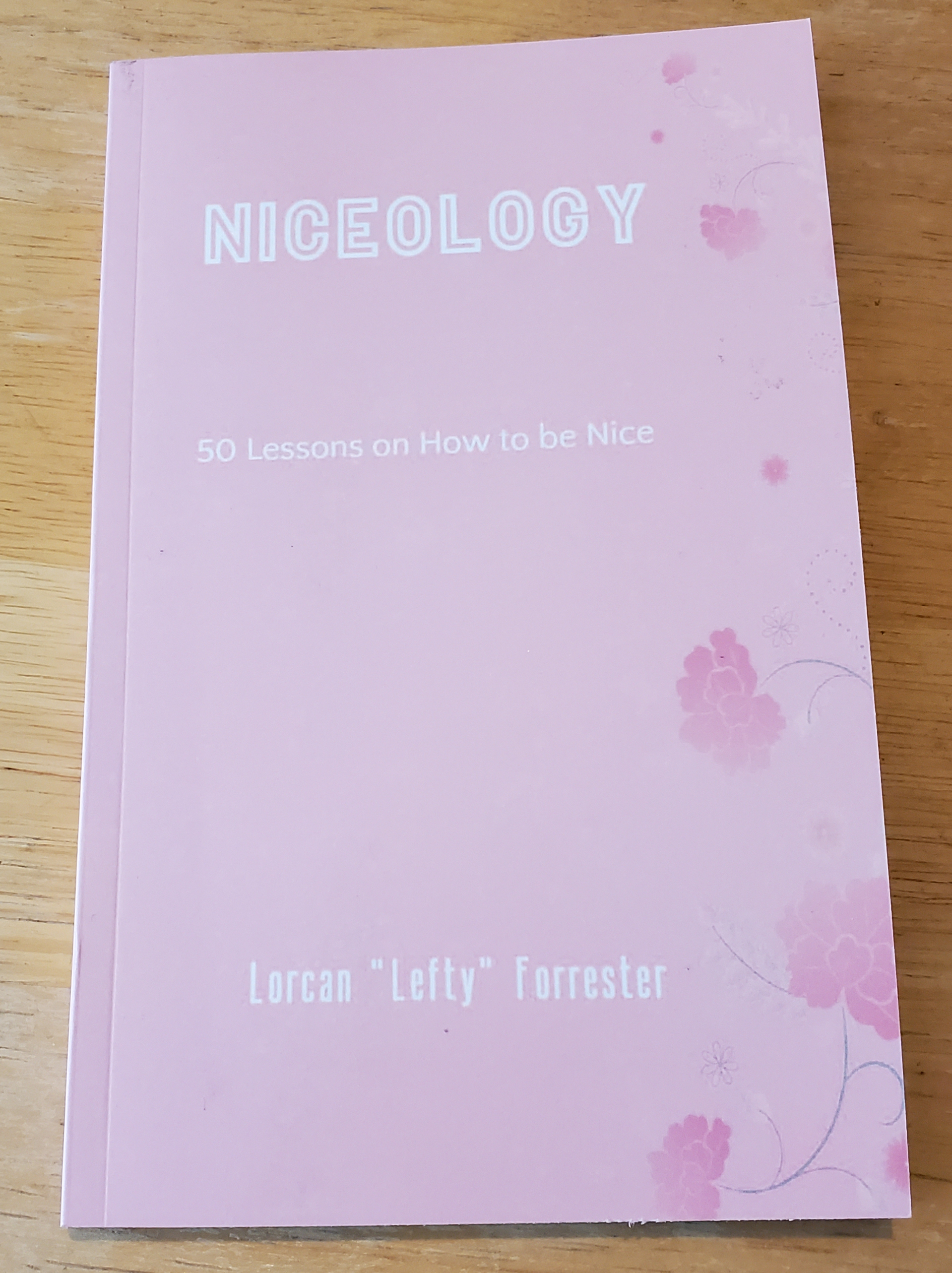
Wouldn’t it be nice if people were, well, nicer? The answer is, “yes,” obviously. It would be better if more people were more nice more often. I was thinking about this one day, and I thought of niceness as a thing to be studied. Niceology, I called it, and I started writing “lessons” on the subject. It is a way to think about niceness, spread niceness to others, and become nicer myself [hopefully]. 

So far, I’ve written fifty lessons on the subject, and I compiled them into a cute little book, which looks like this:

It’s available here https://www.amazon.com/Niceology-Life-Lessons-How-Nice/dp/B093KW3ZQB/ref=sr_1_2?dchild=1&keywords=niceology&qid=1620240921&sr=8-2 if you want to purchase a copy for yourself or for a friend. It’s an easy way to support me. Hopefully I’ll be able to publish some other books I’m working on without amazon, but for now that’s what I’ve got.

Thanks.

High Movie Review #010: history of the entire world, i guess

history of the entire world, i guess is a movie that was released on May 10, 2017 by bill wurtz on youtube. It tells the story of the last 13.8 billion years in the span of 19 minutes and 25 seconds. So obviously it’s fast paced the entire way through. EXCEPT right at the beginning.

So we start of with bill trying to comprehend the incomprehensible idea of the non-existence of time and space. The non-existence of existence is just something that’s so crazy and hard to think about. Even talking about it is hard because you’re trying to say before time and space, but that word before is explaining it through the lens of time itself. You can’t even have “before” if there’s no time. It’s fucking crazy, man. bill explains this idea by saying that there isn’t everywhere, you don’t need a where [space], you don’t even need a when [time]. Then there’s a big pause, the only pause in the movie. Then bill says “forget this” and we launch into the beginning of the universe.

And it’s so funny to me, like nonexistence saying “forget this,” and then existence happens. Like nonexistence is just like “man, this sucks, let’s do something else,” and that’s why the universe exists. That’s such a funny concept.

Everything is anthropomorphized, which gives the movie so much of its charm. Even tiny plant cells, he treats them like people you can communicate with. He sings “now you can eat sunlight!” to the plants. And even later he tells an ocean animal “learn to use an egg,” to which the animal responds, “I was already doing that.” And that adds so much charm. Like it seems like early life was just unintelligent creatures making random choices and evolution took its course, whatever. But they’re important characters in the story of the world, and bill treats them as important characters, shaping the story.

I’m a mammal, so once it became “mammal time,” I was pretty excited. My friends are all mammals too, and to see our development from having breasts, to grabbing things, to walking, to banging rocks together, to setting things on fire, to talking, was incredible to see. We’ve come a long way. And that’s just the period from mammals to the first humans. Obviously we’ve come a long way since 200,000 B.C., as we’ll see shortly.

So there’s an ice age, and people walk to the Americas, which is just insane. Like, I can’t imagine being a person back then and just like “Well, I guess we’ll walk this way.” That’s incredible. Imagine if they didn’t do that, or if they didn’t make it. That would have a colossal impact on the course of history. Of course they weren’t thinking about, you know, the eventual arrival of Columbus or anything, they were just moving. But I like to think about the environmental impact on history. It’s easy to think of history as just people doing stuff because of complex, human things. But obviously they’re doing stuff in relation to the environment that’s around them. It’s no coincidence that these early civilizations developed around rivers, as bill points out.

The movie is very fast-paced. It has to be, given the premise. There’s a lot of brightness and a lot of movement of pictures and quick displaying fo maps and words. It’s a style that is unique to bill and it works so well in this film.

It’s about time to talk about the jingles. These jingles are brief, musical.. things. Basically he’s talking, telling the story of the world then he breaks out into singing! But very briefly. And these jingles are extremely catchy. I find myself just thinking, “It’s the golden age of Indiaaaaaa” randomly in my life.

I think it’d be funny if I ran into some mind readers from time to time. Like a waiter can read my mind, let’s say, for the sake of this bit of fun. So the waiter is about to ask if I have any room for dessert and he hears my brain singing “It’s the golden age of Indiaaaaaa,” and he’s like, in his mind, “Why the fuck is this guy thinking about the Golden Age of India right now?!” Although, come to think of it, if he was a mind reader, he probably has heard some way weirder shit than that. But still, it’s funny to think about.

Another one I like is “Now the Phoenicians can get down to business!” It sounds very cool and it’s fun to sing.

The jingle that I love a lot but don’t really know why it’s in there is “The Sultan of Oman lives in Zanzibar now..” and that’s it! He just moves on immediately. And there’s no buildup to it. It’s like, he’s talking about “The Great Game” between Britain and Russia, and then he quickly tells us where the Sultan of Oman lives now, and then moves on to an Indian revolt and the continued occupation by Britain. It’s like, why the fuck do I care where the Sultan of Oman lives?? No explanation, I love it.

Now I’m not a historian. I like learning about the Cold War and other periods of American history and sometimes British history, but I definitely don’t know much about Asian, African, or South American history. All that to say that there’s probably some significance [of which I am unaware] to the Sultan of Oman living in Zanzibar. But it’s still funny cause it seems like the only jingle whose importance goes unexplained. Here’s the thing: if I learned the significance of the Sultan of Oman living in Zanzibar, I might not enjoy the jingle as much, because part of my enjoyment comes from not understanding.

ANYWAY, in addition to being fun and entertaining, the film’s goal is to tell the story of the world. And it achieves this goal pretty well, given the time restraint. I actually learned a lot watching this. You probably will too. Also you’ll probably find something in there that seems interesting so you’ll go read about it more.

It’s also funny how bill spends more or less time on certain events. For example, he takes a lot longer to explain the Spanish-American War than he does to explain the Black Death. He just says “Whoops, half of Europe just died,” and then moves on. I actually missed it the first time watching. The movie has jingles, charm, jokes, and a kind of dry humor at points. But, you know, it’s talking about real events and a lot of them are pretty brutal, as history is. It’s a strange dynamic, and it makes me think about how the rest of this century will go. I don’t know any exact details, but I imagine it will be quite brutal. Wars, droughts, floods, poverty, starvation, etc. I will be alive during much of it. And I hope to do my own small part to make it not as bad as maybe it could be. I want to do some good, is what I’m trying to say.

As of the writing of this review, the video has 117 million views. If you haven’t seen it, I HIGHly recommend it. It’s one of the best videos on youtube.

Stuck on Specks

I am currently stuck in Denver, Colorado. All flights out of Denver International Airport, including mine, got canceled yesterday due to a blizzard. I haven’t been around snow that much during my life, but apparently this is one of the worst blizzards on record in Denver.

I was at a ski resort about 100 miles from Denver, and I took a shuttle yesterday [while my flight was still active] from the resort to the airport. On the way, my flight got canceled, and luckily the driver took me and the other passengers to hotels. The driver was a very friendly, positive guy and happily conversed with us during the trek. I was the last passenger to be dropped off, and when we were about a block away from my hotel, we got stuck. The driver yelled, “Fuck!” and tried to get the shuttle moving a few times with no success. I’m not sure how that went for him, but I walked through the wind and snow into my hotel. 

During that drive, we saw cars spinning out, a minor accident, cars being towed, and multiple vehicles stuck in the snow. I looked out the window most of the time and, before the blizzard got really bad, I watched some tiny specks of snow land on the window here and there. And that’s just what it was, a speck. A tiny piece of snow that I could squash between my fingers. And yet, I thought, it caused all this. Cars stuck in the snow, people stuck in a city a thousand miles  from home, roads closed, businesses closed, the airport and train stations shut down. Basically, human society, in this area, shut down. All from this from a bunch of tiny specks [and a lot of wind].

And I started thinking about other things like that. Carbon dioxide is an extremely tiny speck. So much smaller than a speck of snowfall. But since we’ve pumped so much of it into the atmosphere in the last 100 years, that insignificant speck has caused, and will continue to cause, much more damage than shutting down a city for a couple of days. In the U.S., extreme weather events are on the rise, and this is a result of this tiny speck that is carbon dioxide [and methane]. Hurricanes and wildfires are getting bigger, more destructive, and more frequent. Harvey, Maria, and Irma were extremely destructive, both in damage costs and human lives. California’s three worst years for wildfires have been in the last five years. 

Ice is melting, sea levels are rising, certain highly populated areas will become uninhabitable for humans. And it’s this little fucking speck. So small you can’t even see it.

That was pretty sad so I started thinking of another example: the sun. The sun is the biggest speck in the solar system, but it emits specks even smaller than carbon dioxide. Specks so tiny that they don’t have mass or volume. Photons. Light is our source of energy, which, you know, we need for living. This infinitesimal speck is the reason we have human civilization at all. And that’s pretty incredible. Flowers, trees, insects, mice, snakes, tigers, humans, we all need that continuous supply of that tiniest of specks. Of course there’s plenty of other specks involved, but the photon is the ultimate source of all we love and enjoy. It is the greatest speck in the universe.

Who is the Hero of Robin Hood [1973]?

Robin Hood was released in 1973. Produced by Walt Disney Productions and distributed by Buena Vista Distribution

The film is a re-telling of a story from English folklore. The legend of Robin Hood, Maid Marian, Little John, Friar Tuck, the Sheriff of Nottingham, Prince John, and King Richard. All these characters are portrayed by animals in the film. 

Upon a casual viewing of the film you might simply think that it’s an interesting story with fun characters and a couple good songs, but as I dug a little deeper into the film, I began to ask myself: “Who is the hero of this film? Who is the hero of the Robin Hood story?”

I initially considered Prince John. He’s a lion, he’s regal, he’s got a crown. And he’s leading England, so you’d think he might be the hero of this tale. But at the same time he’s kind of a wimp, sucking his thumb all the time. He doesn’t have courage, like a hero should. And he abuses his assistant, Sir Hiss. Prince John’s also pretty stupid, getting fooled by these ridiculous digsuises of fortune tellers.

Okay, so what about the Sheriff of Nottingham? Now that could very well be the hero of our story. He is the sheriff, a member of law enforcement, a civil servant. It’s a dangerous job, and he does it with a great sense of duty and honor, maintaining the system of law and order which protects the citizens. He puts his life on the line every day to recover stolen property and return it to its legal, and therefore rightful, owner: Prince John. The Sheriff of Nottingham is the only thing standing between the people of England and complete and utter chaos. That, to me, is a clear frontrunner for the hero of this motion picture.

Now let’s take a look at Robin Hood himself. He is the star of the movie after all. How would I describe him? Liar. Thief. Impostor. And not just stealing stuff here and there, but he commits grand larceny against the crown, using a pulley system to steal bags and bags of money. This is a huge deal, and was probably the “crime of the century” in England at that time. This is a guy who brazenly breaks the law, contributing to the large crime rate of England. He wears disguises to evade law enforcement. Overall he’s just a pretty disreputable character.

He does have a couple heroic things, though. He’s amazing with the bow and arrow, but even that is tainted by the fact that he entered the archery contest under false pretenses. He cheated, in order words. That’s called fraud, and it has no place in a civil society. So his victory was obviously tarnished and, one might argue, completely devoid of any value.

And, you know, he did give his hat to a kid, which was nice. But when you consider Robin Hood, his complete lawlessness greatly outweighs his heroic qualities. I mean, he has such a total disregard for the rule of law, it’s hard to root for him. Maybe if he just applied himself, he could’ve become a professional archer instead of a free-loading anarchist. 

Little John is pretty much an enabler of Robin Hood’s behavior and a frequent accessory to his crimes. He’s so caught up in Robin Hood’s cult of personality that he can’t see him for what he really is: a criminal. Little John is blinded by his admiration for Robin Hood that he actually contributes to his crimes against the state.

And then there’s Friar Tuck. He’s supposed to be a model member of the clergy, a pious, Christian man. Yet, he also enables Robin Hood’s criminal activities, accepting, and thereby encouraging, Robin Hood’s felonies. Hold on a second, let’s see. *flips through Bible* Ah yes, Exodus, here we go. Yes, here we are: “Thou shalt not steal,” does that ring any bells, Friar Tuck? Try practicing what you preach.

This type of hypocrisy can never be considered heroic. 

What about Maid Marian? Again: hypocrite! She pretends like she loves poor people, dancing with them in the forest and playing with the poor children, yet she lives in a castle, living a luxurious life, playing badminton. Typical virtue-signaling, SJW celebrity. They don’t really care about poor people. And she’s an enabler of Robin Hood’s criminal activity, just like Little John and Friar Tuck.

So, after considering all these characters, one would have to conclude that the Sheriff of Nottingham is the true hero of the Robin Hood story. Risking his life, in the face of lawless, dangerous bandits, to uphold law and order for English society. I salute you, Sheriff of Nottingham.

High Movie Review #009: Casablanca

You know how some books get called the “Great American Novel” by literary experts, fans, and critics? And how it’s like it’s a great novel written by an American, but it’s also a novel that encapsulates a certain “American” spirit. It explores the American soul, so to speak. And it’s books like To Kill a Mockingbird or The Grapes of Wrath. Great choices. Well, Casablanca is like that, but in film. The “Great American Film,” encapsulating a spirit, authentic, imagined, or a bit of both, of America. And there are other films like that, like Citizen Kane.

Rick Blaine is a strong, captivating character. He’s neutral [like America at the start of WWII], he’s a drinking businessman. He owns a bar with gambling and music, everyone wants to talk to him, he’s cynical and witty. This film has some of the best-written dialogue in American cinema. Rick’s dry sarcasm makes him such an enjoyable character.

Rick’s is a bustling place with shady dealings and people from all corners of Europe. And it’s in Casablanca, which is like a jumping off point to Lisbon, which is another jumping off point, for refugees. And there’s a murder, so the authorities are looking for suspects. They arrest Peter Lorre at Rick’s bar. Peter Lorre plays a slimy character super well in this movie. Just like the caricature of him in Hair-Raising Hare, that Bugs Bunny cartoon with the big red monster.

The flashback scene where Rick is remembering his great times with Ilsa, it starts off a bit cheesy in my opinion. Not horrible, but them driving a car together, it’s a little hokey. But when it’s them sitting and drinking and talking, that was better. It’s a montage type thing, and it shows the Nazi invasion of Paris. It shows their love together and their life, but I feel like it could have been structured just a bit better. But once it gets to their longer scenes together it works better. Pretty minor, personal complaint. Rick plans their escape, but instead of meeting Rick at the station, Ilsa vanishes, leaving only a short note, so Rick has to leave without her. Pretty heartbreaking, and that’s why Rick is so cynical and bitter now.

Anyway, Rick is miserable, drinking alone in the bar and Ilsa comes back looking for help, so they have a one-on-one confrontation. And Rick’s like “Fuck off! You left me for Laszlo, so fuck you,” and she leaves. So Laszlo talks to the authorities and they tell him that he is not allowed to leave Casablanca, unless he gives them the names of the people working underground in Paris to resist Nazi occupation. Laszlo says he won’t do it, and even if they kill him and everyone else, more will rise up against the Nazi’s, you know, kinda saying that the people won’t ever stand this horrible regime without resisting. And the Nazi is like “maybe people will replace people, but no one can replace you, Laszlo.” [hmm.. some foreshadowing maybe??]

And there’s some other aspects to the plot I won’t go too much into. There’s this fat business man who is.. eh, an okay character.

Then there’s this Bulgarian girl who comes to talk to Rick to ask for some advice/help about getting to America and stuff, and she’s like “Hypothetically, say that a woman [Ilsa] loved you [Rick] very much, and she [Ilsa] did a bad thing [leaving you at the train station and also being married to some guy named Laszlo], would you forgive her?” The Bulgarian girl is talking about herself but the same situation obviously applies to Rick. It’s a bit on-the-nose, but I guess that people from all over can have very similar experiences with romance. So it’s actually not far-fetched that her situation could apply to Rick’s.

Like, if there was a movie about me, and I’m some failing, miserable writer, and some Bulgarian girl is asking me for advice, and she’s like “Let’s say you loved someone so much, and would do anything for them, but in the end they did not love you? And let’s say you were so devastated that even who you were before, carefree and wide-eyed, is gone and you can’t get your old self back, what would you do?” And I’d be like “I don’t know, Bulgarian girl, maybe you should stay in Bulgaria,” but the audience would know that that applies to me as well. But then Rick helps the Bulgarian girl’s husband get enough money to flee to America, and I’d like to think I would too.

Anyway, there’s these letters of transit that Rick secretly has, [that Peter Lorre gave to him], and it looms over the entire movie. It adds a lot of suspense. The characters are invested in what he’s going to do with them, and the audience grows more interested as the movie progresses.

Laszlo wants them, offering hundreds of thousands of francs, but Rick tells him to fuck off. It’s an intense and short conversation, because Rick knows what Laszlo doesn’t. What follows is this battle of music between the Germans and the French in the bar. They both try to drown each other out, but everyone joins in with the French music cause fuck the Germans. But then the German authorities get pissed and tell Claude Rains to close the bar, so he does. But there’s this funny scene where Claude Rains is like “This place is being closed because there’s gambling!” and then some guy comes up to him and gives him money, saying “your winnings, sir.” Hilarious.

Ilsa threatens to kill Rick for the letters, but he calls her bluff and they kiss. And Ilsa tells him the whole truth about how she thought was Laszlo was dead when she met Rick, and Rick’s bitterness starts to crack as he understands her point of view.

Laszlo and Rick have another interesting conversation while Ilsa sneaks home. Probably my favorite scene, as Laszlo tries to dissect Rick, and vice versa. Rick questions Laszlo, about whether this fighting is really worth it. Laszlo claims that is the same as breaething. If we don’t breathe, we die, if we don’t fight [the Nazi’s], the world dies. [Obviously this is the message of the movie, and one that the movie hopes to spread in America] Rick says he doesn’t give a fuck about the world dying, and Laszlo cuts Rick open, saying that he sounds like a man trying to convince himself to believe that. This is applicable even now. People who are bitter and defeated [doomers] will say “I don’t care if the world ends, what does it matter?” And the Laszlo types will say “Bullshit! You are human, you must care.”

The ending of this movie is very exciting. People are double-crossing, people are lying. Rick tricks Claude Rains, then Claude Rains tricks him back, then Rick lies about stuff. It’s suspenseful and it’s done quite well. Passion and love and sorrow and huge decisions made quickly by these characters. And Rick finishes his wide arc and becomes a hero of sorts. He realizes the world is more important than his love for Ilsa. And the last line is absolutely classic. I love it.

As a film it’s basically perfect. The plot, the dialogue, the casting, the performances, it’s all pretty much perfect. There aren’t any real “flaws.” I can nitpick here and there about a couple things I personally don’t love, but even those aren’t really flaws. It is simply one of the most classic American films.

I mean, it does romanticize World War II. Literally, as it is a romance movie in many respects. And that’s all right, romance definitely happened during World War II, as it happens during any time period. But, you know, it kind of also presents an idea that huge implications of the war rested upon the conclusion of a certain love triangle, and.. ehh.. a bit melodramatic. But that’s not really the point! It’s more about the character of humanity during this time, and putting aside your personal stuff for the “cause” of defeating Nazism. Now if only there was a global threat today that we all needed to rise up against.. Hmm.. can’t think of anything.

Great movie. I’m glad that I’ve been able to see it. One of the best.

High Movie Review #008: Peter Pan

This is one of the most nostalgic movies of my life. It’s one of the most nostalgic movies of a lot of people’s lives. By the nature of its subject, the never-ending childhood, it is a nostalgic movie. It produces nostalgia.

As a kid, it’s a super fun movie! With pirates and adventure! But as an adult we look back at it and think, “Yeah, childhood was the best, I wish I could be a child again. It was the best and it’ll never be like that again. But it can be close to it for 77 minutes while we watch this.” I remember watching it, my dad would rent VHS tapes from Blockbuster and then use his VCR to copy the movie to a blank 8mm tape. Voila! We have the movie now! Ye olde retro technologie.

Oh, and the concept of Wendy stealing Peter Pan’s shadow is so interesting. It’s so weird. How did she do it? Like to imagine a shadow as its own being and its own movement is such a weird concept. I would never think of it. And then Link [in Zelda II: The Adventure of Link] has to fight his own shadow as well. Plus they dress the same. And Link [in Ocarina of Time] also has a tiny fairy friend.

ANYWAY, Peter and Wendy have an interesting relationship. It’s kind of a quaint, boy meets girl thing and it’s like your first crush. It’s cute. And Wendy wants to give him a kiss and he’s like “what the fuck is that?” It’s not so much like “perfect romance, love at first sight, happily ever after,” thing from the earlier Disney movies.

John is like the kid who’s trying to act all grown up. “I’m John. How do you do?” he says pretentiously. Some kids loved to act like they were mature for some reason. Not sure why they thought that maturity was the coolest quality to have. John’s like that. There’s a couple lines I like where John is being all fake mature like “I’d like to cross swords with some real buccaneers!” and Michael’s like “Yeah! And fight pirates, too!” It’s funny, Michael doesn’t know what the fuck a buccaneer is. And saying “fight pirates” gets the message across. Stop trying to act all smart and mature, John. Not a big fan of John, to be honest.

Tinkerbell’s kind of a bitch. She’s like “Oh, Wendy’s getting some of the attention, better kill her!” Kind of an overreaction, I’d say. She doesn’t kill her, but she flies super fast and tells the lost boys to shoot her down. Kinda fucked.

I love Mr. Smee, he’s so fucking funny. He’s like this jolly, cheerful pirate and they’re all acting like the stereotypical angry, rum-drinking, tough guy pirates. But he shows up and says “Good morning shipmates!” And he gets bullied for being positive! Classic. “Why are you trying to make people happier?! Fuck you!!” That’s what those pirates are saying, essentially.

The way the movie portrays Indigenous people of the Americas is very bad. Very stereotypical, very caricature-ish. I’m not gonna defend it. It’s not good. I’m not a sociologist or whatever, but maybe if you’re gonna show this movie to your kids, you can explain what stereotypes are and how they work and stuff.

But back to the plot. So Captain Hook and Peter Pan are eternally at odds with each other, and Hook seeks to kidnap Tiger Lily and coerce her into telling him where Peter Pan’s hideout is. So he does that, but then she’s saved by Peter and Captain Hook runs away from the crocodile who swallowed a clock. That sounds like something made up by Alex Jones. “The freaking demon masters are feeding clocks to the crocodiles!! They’re mind control clocks, people!!”

Oh yeah, and the mermaids also get jealous of Wendy and try to kill her. Man, Neverland seems to foster jealous and murderous girls. Except Tiger Lily, she’s chill. But then Wendy gets really jealous of her, but at least she doesn’t try to kill her.

Wendy says some nice words about mothers. It’s actually very sweet and she sings a song too. It’s kind of strange, this important theme about mothers in a movie where the actual mother is hardly in it at all. It’s kind of like that thing where parents treat their eldest daughter as the third parent. The Darlings definitely do that with Wendy. They expect Wendy to raise their other kids while the parents go out and do rich people bullshit. They even expect the DOG to be another parent. Shitty parents. The dad kinda reminds me of the dad from Mary Poppins. They’re both rich and neglectful fathers named George who live in Edwardian London. But the key difference is that one has kids named John and Michael, while the other has kids named Jane and Michael. Totally different characters, those George’s.

Anyway, Hook captures Tinkerbell and tricks her into showing him Peter’s secret hideout. The pirates kidnap Wendy and the lost boys and give a time bomb to Peter. Looking pretty grim, I hope Peter doesn’t die in an explosion! Luckily Tinkerbell gets out just in time and saves Peter but almost dies. It’s a pretty sad moment as Peter is searching for her. It shows how strong the bond is between two characters even though they had kind of a falling out earlier. They still love each other. I know I said earlier that she’s a bitch, but she redeemed herself here.

There’s a cool showdown between Peter and Captain Hook. There’s dueling and sword fighting and.. swashbuckling? Was there swashbuckling happening? Was there some swash being buckled?

Peter wins and Hook swims away, pursued by the clock-eating crocodile. A clock-odile, if you will. And they fly back to London and it’s all very magical.

Peter Pan is such a cool character, but more so he’s an awesome concept for a character. An adventurous kid who never grows up. I feel like there could be a whole bunch of Peter Pan-type characters. A never-aging kid having adventures in Manhattan. A never-aging kid exploring jungles and rivers. A never-aging kid stowing away on trains, traveling the world. Maybe there are a bunch of never-aging kids in literature and I just never found out about them.

Peter Pan is a good movie.

High Movie Review #007: Alice in Wonderland

Okay, now THIS is a movie to watch while high. It’s part of the whole psychedelic, stoner, drug culture thing. The colors, the whimsical nature of it, the weird fanciful story, it all adds to the weed/psychedelic drug culture. But that hippie/hipster/druggie thing didn’t really seem to be the mainstream until the second half of the 1960s, but this movie came out in 1951. The early 50s were marked by extreme conformity. Men worked and women cooked, men wore suits and hats, women wore dresses, men had short hair, everyone was pro-U.S. and anti-communist, everyone lived in rows of houses that looked exactly alike. Deviation from the norm was highly suspect. So this movie is kind of ahead of its time, I would say. You’d think it would have been released in 1968. I get that it’s still a cartoon “kids” movie, but if there’s any Disney movie that’s a stoner movie, it’s this.

Anyway, Alice starts off by wishing that she could live in a world of nonsense, where there’s no rhyme or reason or logic at all. Then she immediately regrets it. She wanted a world without reason, then she’s mad like “Why is this talking doorknob not using logic? Why is he making no sense? Why is this smoking bird telling me to get dry by running around in the water? Why does no one make sense?” Girl, you asked for this. 

There’s so many characters in this movie, and, even with small screentime, they make strong impressions. Like the Mad Hatter is not in the movie for the entire movie. He’s not in it all that much, but we really know the Mad Hatter, he’s a full side character, and this movie is full of full side characters. The Mad Hatter, the Cheshire Cat, the March Hare, the Walrus and the Carpenter, the Caterpillar, and the Queen of Hearts are all great full side characters.

I like the Walrus and the Carpenter the best. I used to love reciting his rhyming song/poem/dialogue. To talk of other things, like shoes and ships and sealing wax [I thought it was ceiling wax as a kid], cabbages and kings! I love that. Makes no sense, but it’s fun to say!

The voice of the White Rabbit is so funny to me. He’s perfectly frantic. And the way he calls Alice “Marianne!” [or Mary Anne?] adds a certain flavor to the nonsense that I like. Having someone think you’re someone else, and refusing to change their mind, is distressing and weird. Honestly, all of the voice acting is amazing. The Mad Hatter is perfect, the Cheshire Cat is perfect, the Walrus is perfect, the Queen of Hearts is perfect. I think it’s interesting that the voice of the Queen of Hearts is the same person as the voice of the Fairy Godmother. She’s so soft as the Fairy Godmother but in this movie she screams!

I like the dark aspects of this movie because they’re not as “in-your-face” as other Disney movies. With this movie it’s like it’s dark when you think about it a bit. Like the Walrus and the Carpenter scene portrays the oysters as like little kids, but then they just get devoured. Pretty dark, but it’s not presented in a dark way. It’s whimsical! Also they blast this lizard way up in the sky to his doom. And the bird just dismisses it like “There goes Bill..” And then there’s the Queen ordering executions by decapitation for trivial things.

I hate those flowers though, they’re assholes to Alice, making fun of her. Fuck them, especially that one flower that has glasses, she’s the worst. But the scene is still beautiful. Giving the flowers faces and personalities and musicality was done perfectly. And the song is lovely. The Caterpillar is kind of a dick too, screaming in Alice’s face. 

There’s never a dull moment in this movie. The Mad Hatter scene has the most chaotic energy of the whole movie. There’s so much going on, so much being said, so much being done, and so much to look at. It’s awesome!

I think this is one of the best Disney animated movies of all time. It’s the most fun. Get high and watch it!