High Movie Review #006: Cinderella

Cinderelly, Cinderelly, something something Cinderelly. That song really gets stuck in my head, and now, perhaps it might be stuck in yours. The power of words at work.

So Cinderella’s parents are dead. Because of that, she lives with her stepmother, an absolute BITCH named Lady Tremaine and her two daughters who are annoying as fuck. They treat Cinderella like shit.

They have a cat named Lucifer. What the fuck?! Who names their pet Lucifer?? Kind of a bad guy, if I recall correctly. Then Cinderella meets these mice and names one of them Octavius, and then calls him “Gus” throughout the movie. Why is Gus a nickname for Octavius?? It’s not even close!! Wait, it’s because of Caesar Augustus?!? Because he changed his name from Octavius to AuGUStus!! That’s what it comes from?! That’s stupid. And what’s the deal with the Prince not having a name at all? In both Snow White and Cinderella, it’s just “the Prince,” but why? Why don’t they have names? Perhaps a name would ruin their perfection. They are perfect, handsome, charming princes, and to give them a name would be a blemish. There is no perfect name, but there is a perfect, archetypal “Prince.” Speaking of names and princes, there was a real guy named Prince! And there was an interesting time when he changed his name to a symbol, I think it was a contract dispute thing.

ANYWAY, Cinderella has to work all the time, and she gets treated poorly by Tremaine, but she still has hope, singing songs and wishing for a better life. “A Dream Is A Wish Your Heart Makes” is a beautiful song which sets the tone for Cinderella’s character and the tone of the movie in general. It’s kind of like “I’m Wishing” from Snow White, but better.

So the Prince is handsome and rich and charming and irresistible, BUT he’s not married, he’s not even interested in any girls. This makes his dad angry! He’s upset that his son is not providing grandchildren. It’s honestly so weird when parents do this, pressuring their kids to have kids. So entitled to have grandchildren. “I’d like to see my grandchildren before I die,” they say. What? Fuck you. I’ll have kids when I want or not at all. I don’t owe you a grandchild.

 So the king organizes a ball in the hopes that the Prince will meet someone, fall in love, and get married. Of course, Lady Tremaine wants one of her bitchy daughters to marry the Prince, and then they tear up Cinderella’s dress to prevent her from going to the ball! That’s so fucked up! Honestly, this movie will make you want to kill those step sisters. 

Luckily the Fairy Godmother shows up just at the perfect moment! Where was she this whole time Cinderella was being so mistreated?! Okay, it’s just a fairytale, who cares.

The king and his monocle-wearing assistant do some slapstick-type humor, falling over each other and stuff and it kinda throws off the magical mood. I get that it’s “comic relief,” but it just feels so out of place. The comic relief earlier, with Lucifer and Gus and whatever, that’s fine, it fits, but the ball scene is supposed to be this perfect, romantic, idealized thing and then you have a guy falling on his fat ass. It just kinda throws everything off. But those shenanigans end, and the Prince and Cinderella dance. It’s, you know, a love-at-first-sight, magical, romantic, happily-ever-after moment. But the clock strikes midnight and Cinderella has to flee because the fairy godmother’s spell only lasts until then for some reason.

So the monocle guy tells the king that Cinderella got away, which pisses off the king. And the king is trying to kill the monocle guy and then the monocle guy is like “No wait! Remember, your blood pressure!” Even as a kid, I thought that was a funny line. It just seems so modern or something. Like, were they concerned about King William IV’s blood pressure? Then they fall from the chandelier and there’s this Goofy-sounding scream. Like it sounds like Goofy, the character. Super weird. Watch this movie again and listen for  that scene. It’s literally Goofy.

But they have the glass slipper, so they’re gonna try to see who it fits, then the Prince will find the girl and marry her. But Lady Tremaine figures it all out and locks Cinderella up. What an absolute petty, jealous asshole! Then there’s this cool little battle scene between the animals and Lucifer. It’s like a little showdown to get the key to Cinderella. Lucifer wins but then Bruno comes in and kicks Lucifer’s ass. The slipper breaks but Cinderella reveals that she has the other slipper somehow. She tries it on, it fits, and she and the Prince get married and live happily ever after.

Overall, the movie’s fine. It’s a classic, and it doesn’t have any huge flaws or anything, but it’s definitely not for everyone. It’s just very.. Disney-like. The princess who speaks to animals, the mean stepmother, the charming prince, the happily ever after, it’s like the Disney fairy tale of all Disney fairy tales. It’s one of the most romantic Disney movies, and I just don’t really care too much for romance overall. BUT, if you like that stuff, you’d love this movie. Obviously I’m not the target audience, it’s not like Walt Disney in 1950 was like: “Hey let’s make a movie for a 21st Century, stoner guy in his mid-20’s!”

High Movie Review #005: Bambi

I love deer. I think they are among the most majestic creatures on this effing planet! 

Bambi is about the passing of time, getting older. From the day we are born, moments pass. We struggle to walk, to talk, we learn new words. We meet new people, we make friends, and sometimes those friends find themselves a partner, and you drift apart. Seasons change. Our loved ones die. We grow older. Time passes. We might become more serious and less playful as we get older. That’s all what Bambi does too.

So the movie is famous for being sad. We know that it is one of the saddest animated movies in history, but at the time of its release, it was the only sad animated film. Snow White and Pinocchio had some sad individual scenes, but Bambi is overall a sad movie. And not to be such a fucking downer, but life is sad. Everyone you love, or have loved, will die. There’s someone dying right now. It’s unbearably sad. Everyone talks about the death of Bambi’s mom, and it is really sad. But there’s a scene later which is also tough to watch. There’s these birds hiding from the man, who is approaching. And one of them wants to fly away, but the others warn her not to. She starts panicking, terrified of the imminent threat. She gets so scared so she flies, and gets shot right out of the air. We see it fall dead to the ground.

There’s this owl character that I love, but he’s also weird. Spring comes and there’s birds chirping along, and the owl is like “shut the fuck up! I’m trying to sleep!” He’s a grumpy guy. But then Bambi, Thumper, and Flower show up and the owl goes into this weird explanation about horniness, which he calls “twitterpated.” He’s like, “you’ll just be walking along, minding your own business, then you’ll see a pretty face and you’ll get horny [twitterpated] and you’ll start acting all strange.” I guess that’s true, in a way.

Anyway, Bambi likes this girl, but a mean deer is trying to take her from him, so Bambi fights the mean deer. This scene is really strange to me. The animation changes to this silhouette-looking style which I don’t like. Kind of a minor complaint, and I would say that, other than that, the animation is quite appealing. There are some beautiful scenes of meadows and waterfalls and trees. 

This movie is also about mankind’s relationship with nature. We destroy it. We kill it. We BURN it. And we’re still doing that. Quite sad.

Like Dumbo, this movie suffers from a minimal amount of character development. Bambi just doesn’t say much. He’s more emotive than Dumbo, but I’d still be surprised to hear that anyone’s favorite Disney character is Bambi. In the end, Bambi and the girl deer, after becoming sufficiently twitterpated, bring two new deer into the world. Bambi is now a stoic, watchful protector of the forest. 

The movie is.. okay. The images of the forest and the changing of the seasons look very good, but the film is lacking in substance. It definitely could have used a more well-defined main character, like Pinocchio or Cinderella, characters who were brought to screen around the same time period.

Why You Should Watch Metropolis

I read an article recently, which inspired me to write this “essay.” It’s not really an essay, though. It’s too informal. I don’t follow those BULLSHIT rules that English teachers forced upon us. I write how I want! LIKE A STREAM OF THOUGHTS, as if I was TALKING. HOW’S THAT FOR AN ATTENTION-GETTER?

The article asserted that Jeff Bezos is on pace to become the world’s first trillionaire by 2026. Interesting. So what am I writing about? Well, I’m urging you to watch a silent movie that was made in 1920s Germany. 

The movie is Metropolis. It was directed by Fritz Lang and released in 1927. The movie’s setting is kind of up for interpretation, to some extent, but one release explicitly states that the film takes place in the year 2026. It’s just around the corner, really. 2014 and 2026 are the same amount of time removed from our present moment. And 2014 doesn’t seem that long ago, at least to me, anyway, I’m not sure what your perspective is. 

Metropolis is almost one hundred years old and it takes place in the very-near future. 

But movies are always wrong when they predict the future, right? Like Back to the Future Part II, they said that in 2015 we would have self-lacing shoes, hoverboards, and flying cars, but we didn’t have any of that! Yes, many movies are wrong with their predictions, but most do get a few things right. 

Metropolis portrays the year 2026 as a world in which a select few elites enjoy a life of leisure, luxury, and decadence in beautiful giant buildings, while the masses toil away for long hours in dangerous, grueling jobs just to be able to survive. And the elites enjoy their status because of the work of the many who still live in squalor. There is a clear causality between these two classes. The inequality is painfully obvious. This is why it’s a perfect movie to watch right now. Yes, it’s old. Yes, it’s silent. But it’s just as relevant now as it ever was. 

Today, just a couple dozen individuals own the same amount of wealth as the poorest half of the planet. Billions of people. Global wealth inequality is really bad, and it’s getting worse. 

So yes, a German-made, silent movie from 1927 is relevant to your life. 

Anway, one of these elites has a son named Freder, who inadvertently discovers the horrible, dangerous, impoverished conditions of the workers when a woman named Maria brings some poor children to see Freder’s home. Freder begins to sympathize with the workers, and he recognizes that the workers look to Maria as a beacon of hope, a savior of sorts. Freder, Maria, and some workers have a meeting of sorts and start planning a rebellion of sorts. 

The elites realize that their extremely luxurious position might be the tiniest bit threatened, so they freak the fuck out. They design a robot, a fake Maria, to disrupt the workers’ plans. 

This movie has wealth inequality, class solidarity, artificial intelligence, revolution, and phony class heroes. Phony class heroes? That sounds familiar.. you know, people like Nancy Pelosi, Hillary Clinton, and dare I say Barack Obama?? Yes, I dare say. These are the fake Maria’s of the world. They act like and seem like they are fighting for you and me, the everyday people. They say they’re on our side, on the side of the disenfranchised, but they’re not really. They, and other “liberals,” march on towards more imperialism, more mass incarceration, more surveillance, more love for corporations and less love for the workers of the world. 

So watch Metropolis! Get some class solidarity!

But what I’m trying to say is more relevant to the uber-rich than it is to these “fake Maria’s” [I just wanted to mention that, as it’s another minor correlation between the film and the real world]. In the film, the elites live in luxury while their workers spend almost every moment of their lives working and living in shit conditions. 

A recent report indicates that Bezos’ net worth has risen over $30 billion during the pandemic. Amazon cut hazard pay to its warehouse workers while handing out “Thank you” t-shirts. A “fuck you” followed by a “thank you.” Classic capitalist. Bezos lets workers pee in bottles in his warehouses, he designs bracelets to track his employees’ every movement, he uses heat maps to prevent workers unionizing for better conditions [like a living wage]. There was an Amazon employee video wherein employees were advised to turn in their fellow employees to management if they heard them say “living wage.” Fuck him. 

There’s other evil shit and evil implications of Bezos’ actions and inactions, as well as companies like facebook, google, and others.

So watch Metropolis! Get angry! Get that radicalized, motivating feeling! Watch the movie!

Also, it’s just brilliantly directed, in that German expressionist way. And the visuals are pretty impressive for its time. And won’t you be a more interesting person after you watch it? Like, wow, that guy watched a silent movie, how cerebral! He must have such great focus and appreciation for art and shit. You might start calling movies “films” from now on, since you’re such an intellectual.

Of course, Metropolis does get some things wrong. The film suggests that those on top, the elites, are on top largely because they are the smartest [though of course the film clearly indicates that they retain such a lofty position because of the labor of the workers]. The film’s main phrase,“the mediator between Head and Hands must be the Heart,” is to be interpreted as “the compassion/empathy [heart] of the elites [the head/mind] must bridge the gap to the workers/labor [hand].” The elites are not the smartest, first of all. They’re not the stupidest, either, but Bezos is not 140,000,000,000 times smarter than anyone. Secondly, the elites have had plenty of time to develop compassion and empathy for the workers of the world, but they don’t. They never will. It’s pointless to hope that they will ever develop the “heart” that mediates between themselves and the common man. Fuck them.

So watch Metropolis, gain some class consciousness, and who knows, maybe we’ll fight for a better world? That’d be cool.

High Movie Review #004: Dumbo

Dumbo starts with a bunch of storks bringing down baby animals to a bunch of circus animals. All at once. There’s like a huge army of storks delivering babies to everyone. Imagine growing up and everyone has the same birthday. The insanity!

Anyway, one of the babies is an elephant with big ears. Then these other elephants, like adult female elephants, start making fun of this baby, calling him “Dumbo.” They’re just being complete assholes to a fuckin baby! Pisses me off. At least Dumbo’s mom slams the door in their stupid faces. Dumbo’s mom is pretty cool, not taking their shit.

Dumbo’s cute, but he’s always getting laughed at because of his big ears. Some jerkoff kid even pulls and pushes Dumbo, and yells in his ear. When his mom tries to defend her son, she gets locked chained up in a tiny train car in isolation. The movie is about the circus, and kinda some of the shittiness of being in a circus. It’s not a huge theme throughout, but I think it’s there, the unfair treatment of circuses. It’s just not particularly relevant in our society, I think. Maybe I’m out of touch, though. Maybe circuses are hugely relevant somewhere. I don’t fucking know.

Then Dumbo meets this mouse with a Brooklyn [?] accent. Some kind of accent. He scares off those bitchy lady elephants and befriends Dumbo. He accepts Dumbo for who he is and encourages him. He’s a pretty good character. He kinda plays a similar role to Jiminy Cricket in Pinocchio, but Jiminy was way better at it. Speaking of Pinocchio, that had over twice the budget of Dumbo, and it shows. Dumbo just doesn’t have the richness, the depth, or the artistic quality. It’s simpler in every way. It’s not bad, but it’s not anything incredible.

There’s a scene where Dumbo visits his mom when she’s locked up, and it’s kind of emotional. They show all the other animals with their mothers, but Dumbo can’t really visit her. She’s still locked up. It’s sad. But, you know, the characters are just kinda okay, so it definitely could’ve been an even better scene with more budget and a longer movie.

The best scene, of course, is the “Pink Elephants on Parade” song. Dumbo and the mouse guy kinda accidentally get drunk, and Dumbo hallucinates, for some reason. This scene is so ahead of its time. It’s so psychedelic, you’d think it would be from 1967, but it’s from 1941!

When Dumbo and the mouse guy wake up, they’re greeted by a group of crows. These crows are obviously meant to represent African-Americans, and to me it seems really racially insensitive. But, looking at the Wikipedia, I guess there’s some debate about it. I’m not really the one to have the final authority on the matter at all.

But they give Dumbo a “magic feather,” which allows him to fly. In the end, he loses the feather, but he can still fly, so he realizes it was really just him all along! And it was his ears, which had caused him such anguish earlier, that allowed him to fly! It’s a movie about loving yourself, kind of. A lot of us have our own “big ears” that we have to accept of ourselves. 

This movie could’ve really used a villain. There’s a few asshole characters, but if they had developed the ringleader as a true villain, that would’ve made it a lot better. Oh well, can’t change it now!

High Movie Review #003: Fantasia

Fantasia was released in 1940. It’s not really like any other movie [except Fantasia 2000]. But like, for sixty years, there was no other movie like this. It’s like a concert of sound, of sight, and of imagination. It’s pleasure for the ears, the eyes, and the mind. 

It starts with the Toccata and Fugue in D Minor, which was composed by Johann Sebastian Bach for the organ, but in this movie it’s arranged for the orchestra. At first we see the musicians, and looking back, it would’ve been better for them to just start animation right away. I guess they were trying to like slowly lead the audience into the idea of a Fantasia movie, and they thought that jumping straight into just animation and music may have been a bit jarring, and showing the band play would indicate that this movie is going to be kind of a concert. I get it, but they should’ve just done all animation, the whole time. I’d actually prefer to watch this movie with just section after section, with no introductions or fillers. But that’s not the way it is. There’s little monologues between sections. Eh. Just get rid of those.

Then we go into the Nutcracker music. And I like the Nutcracker music. The art is beautiful, and each subsection has its own feel, there’s fairies and leaves and mushrooms and fish. Beautiful. They say Tchaikovsky hated his own Nutcracker music.. what a moron! It’s great music! I’m smarter than him!

After that is the section that has the most story: The Sorcerer’s Apprentice, starring Mickey Mouse. You know Mickey Mouse, don’t you? The ruler of Earth’s media machine. The tyrant who commodifies happiness, squeezing every bit of nostalgia out of you. No longer concerned with creating artistic masterpieces, they simply rehash old ideas to be consumed by the masses. They pump out movie after movie from the franchises they’ve bought, raking in billions. This scene is so much fun. Mickey gets arrogant with his magician’s skills and tries to take a shortcut, enchanting the brooms to do his hard work, so he can relax in luxury. But it backfires. There’s a certain magical flair to this scene, with Mickey making the stars shine in the sky and the waves crash into the mountain. 

Like many of the early Disney movies, Fantasia is racist. It’s not racist throughout the entirety of its runtime, but there is a disgustingly racist scene, which has been removed from the movie in re-releases. I think that’s a good decision. I mean, I’m just a white guy, so I’m not the person to make those kinds of decisions. But, you know, it’s a movie that existed, and it had a very racist caricature of a black person in it, and it’s important to recognize racism’s impact and influence in the history of cinema, such that we can work towards a better present and future in film. And perhaps with Fantasia it’s best to acknowledge it, decry it, then remove that particular scene and keep re-releasing the movie. It’s a short scene, it’s easy to remove, and the rest is a great movie, and you know, maybe a black kid would watch this movie and love it, and start to get interested in animation or art or classical music. It’d be a shame to remove that possibility altogether. Probably good to approach it as a case-by-case thing. Like, it’s probably a good idea to not re-release Song of the South at all. 

Anyway, the Beethoven/Greek mythology scene makes me feel like I’m a beautiful creature with clear skin and no joint pain. I’m frolicking around joyously without a care in the world. And I’m eating a juicy, refreshing apple. And there’s other smiling, frolicking people around. And I splash around in a river playfully. And I lie in the grass, the sun shining down on my skin. You know that feeling? When you’re at the pool or the beach or the lake, and you swim a bit, and it’s refreshing, then you get out and just lounge in the sun. That feeling when the sun warms you up. It doesn’t burn you, it warms you. It feels good to be alive, to be able to feel the warmth of the sun on your skin that’s full of life! That’s true warmth. Bliss.

That’s how the Pastoral Symphony makes me feel. 

That is, until Zeus shows up, the absolute BASTARD! 

The next section is the Dance of the Hours, by Ponchielli. This is one of the most fun parts. There’s ostriches doing ballet, and eating huge things. There’s these elegant hippos dancing around. There’s these conniving crocodile guys. And the elephants are scared of the crocodiles. It’s a lot of fun.

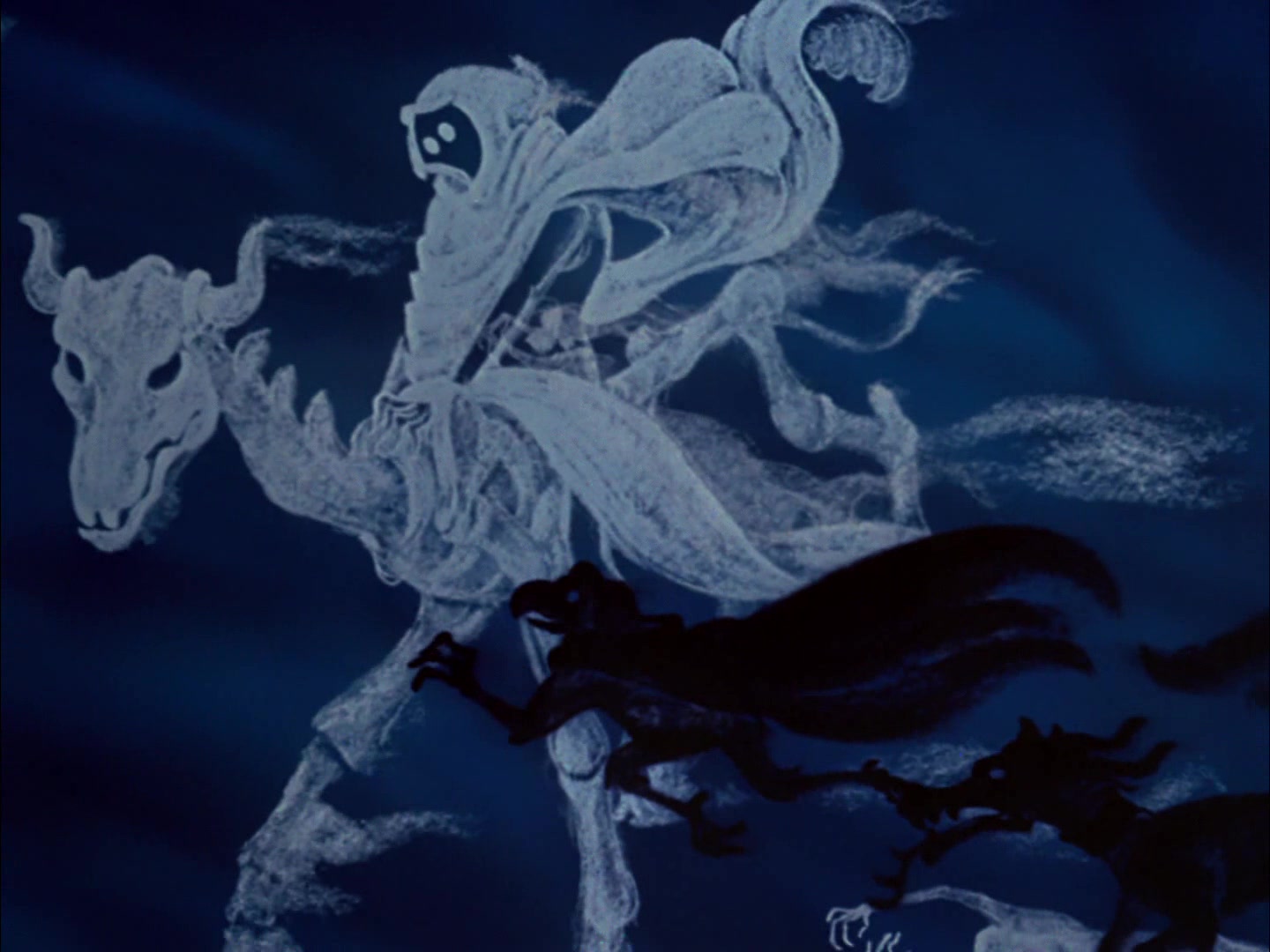
The NEXT section is the Night on Bald Mountain by Mussorgsky. It’s about Chernabog, who’s kinda like the devil or something. It’s pretty horrifying, and really dark. It’s part of that whole thing, where Disney has the facade of being really sweet and “Wholesome ™” but they have a bunch of really dark, scary scenes. In a way, that’s one of the creepiest things, when something has the illusion of being sweet and innocent, but really it’s sinister and evil! You see it a lot in horror movie trailers and stuff, some little girl singing “Mary had a little lamb” really slow and creepy-like. It’s supposed to be a sweet song that a kid would sing, but now it’s sinister, which makes it extra creepy and scary. 

Some of the animation here doesn’t work well for me. Like, Chernabog is on the mountain, and he’s calling souls to him or whatever, and some are like “ghosts” riding pegasus skeletons. They’re trying to look kind of translucent, but it just kind of comes across as an incomplete sketch:

Disney Readying Iconic Fantasia Scene Live-Action Chernabog | The Mary Sue

Just doesn’t look very good, in my opinion.

The final section is Ave Maria, by Franz Schubert. Such beautiful music. Even if you’re not a religious person, this is just an emotionally powerful piece of music. The slow-paced animation gives us a soothing finale to an epic experience.

But yeah, this is an incredible film. Beautiful animation and beautiful music. And just the concept of this movie is insane. To do this animated film/classical concert was so unlike anything else. It was gutsy, I mean, an animated, epic piece of art, no one had ever done that before. It was risky, cause it could’ve totally sucked! But it was great! If I recall correctly, I think Walt Disney actually wanted to make a bunch of Fantasia movies, that they could be released with some new segments, some old, kind of like a classical concert. Obviously that didn’t happen, and it took 60 years to make another one. Personally, I would love to see more Fantasia-esque movies. Perhaps it’s not a good financial decision to make those movies.

High Movie Review #002: Pinocchio

Pinocchio! I love this movie! I’ve always loved this movie so I may be viewing through a biased, nostalgia lens. But is that so bad? Is it so bad to have nostalgia? I like and remember that thing, and that makes me happy and sad at the same time. Isn’t that what nostalgia is? Must it be a sign of weakness??

Anyway, this movie starts with the song “When You Wish Upon A Star,” and I think it’s the greatest Disney song of all time. It’s just so beautiful and it perfectly encapsulates that “Disney magic feel.” I know it’s so fuckin cheesy to say that but it’s what Disney’s good at, that “magic feel” about wishing and dreaming and happily ever after. The melody is so rich and Cliff Edwards sings it beautifully. 

Then we get into Geppetto’s workshop and it’s all these clocks, and decorations, and furniture and scraps of wood, it’s so rich. This is what I’d say to this scene: “Ya look gorgeous, baby!” 

Jiminy Cricket serves almost as a fourth-wall breaker. He says some comments about what’s going on. And it could be him just talking to himself, but it’s like he’s talking to us too. He’s like “Not at all practical,” and “What does an actor want with a conscience anyhow?” kind of to himself, but kinda breaking the fourth wall. It’s kinda fun. 

And the opening to the town scene: beautiful. The camera moves forward, moves down, goes down a street. It really feels like a real world and the camera is traveling through it, as opposed to just: here’s a background, here’s a character. Pinocchio makes it feel like a world we could be in. It’s got DEPTH. The depth of this movie is incredible. This world felt like it was “lived in,” like it was a world that had all different characters living in it that weren’t in the movie. 

The villains are sinister. Honest John’s a dastardly fellow. Just out doing some scams, some schemes to make a quick buck. He tricks Pinocchio into becoming an actor for some quick cash from Stromboli. It’s just a scam. This gives Honest John a sense of plausible deniability. “I didn’t do the horrible things to Pinocchio, Stromboli did. I didn’t know what was gonna happen, I just facilitated the whole deal and profited off it. It’s Stromboli you’re after!” 

And Stromboli! He sees Pinocchio, an obviously sentient and intelligent being, and enslaves him. He ignores his pleas for help, he locks him up, and forces him to perform so that Stromboli to get rich. And, Stromboli says, once Pinocchio has served his purpose, Stromboli will kill him, turning him into firewood. And is that not the true evil of Man? To look at your fellow Man, and to consider his emotions inconsequential, his passions unimportant, his free will nonexistent, and his body disposable. Is that not Evil?

Anyway, the Coachman, somehow, goes further. He’s just as ruthlessly obsessed with money as Stromboli, but his approach is even worse. He doesn’t just want to enslave a puppet boy for his own enrichment, he wants to enslave/transform a multitude of boys,  mutilating them into donkeys. In essence, he destroys them. 

The movie is also about Temptation.

And Pleasure Island. This is kind of a theme of morality back then. There’s a great fear of degeneracy, impurity. People need to resist the temptation of the bright lights, cigars, drinking, excess, vandalism, and.. BILLIARDS. Anything like that has to be shunned. People devolve when they engage in these behaviors. This is clearly shown in the movie, as the boys who couldn’t resist the PLEASURE Island devolve into donkeys. They’re punished for pursuing pleasure.

I’m not sure I agree with that point, at least not to this extreme. Sure, some excesses and pleasure are unhealthy, but some are still just kinda fun! And fun has value! It’s fun to drink a few beers and play pool! That isn’t any serious evil crime! Fun is good sometimes.

But, in their scenario, engaging in pleasure sends you into a damnation of being a donkey. I just feel like, we can feel pleasure, it feels good, and we should enjoy it while we can, as long as you’re not too dangerous and you don’t harm anyone else. You don’t deserve some real-world equivalent of a donkey curse, do you? 

And while I may not completely agree with the moral message, it’s very interesting. And the overall theme is more about resisting temptation in general, and I like thinking about that concept. Temptation seems like it’s just “wanting to do something,” but it’s more of “wanting to do something with the belief that the thing is actually ‘bad.’” 

Anyway, then there’s MONSTRO THE WHALE. He has no morals, no moral lesson or metaphor. He’s just a force of nature, a monster. What a perfect name, Monstro. We love a good old-fashioned Monster movie. The Monster, whether it’s King Kong, Godzilla, Frankenstein’s Monster, the Cloverfield Monster, the Alien, or the shark from Jaws, no matter what they’re called, the people in the movie know them just as “The Monster.” And we like that. Or some of us do, anyway. 

This movie is dark. There’s a lot of scary scenes, including Lampwick panicking as he’s transforming into a donkey. As his body is mutated into that of a donkey, it sets in with Lampwick’s mind. He realizes what’s happening and he can’t stop it, and true Terror sets in. It’s really a horrifying scene, a boy fading away, he wants to stop it but he can’t control it, and he is consumed by fear. It’s like, that scene just exudes so much panic

And just contrast it with Snow White. Snow White had a couple scary scenes, sure, but overall the movie is happy. The good guys win, the bad guys lose, and the heroes live happily ever after. But Pinocchio is not like that. Sure, it’s a happy ending for Pinocchio and Geppetto, but what about the dozens of other boys? What about the Coachman? That evil was not defeated at all! They didn’t end that evil. He’s still tricking, mutating, and enslaving young boys! His human trafficking ring is still going on without a hitch. Pretty dark. But I guess that’s kinda the thing about the really early Disney movies. They’re dark.

It’s like, a guy really sat down and drew this:

and thought, “Yeah, this would be good for kids to see.”

But, like, yeah, the Coachman is not defeated. The Evil Queen falls off the cliff, Ursula gets destroyed by a ship, Scar gets eaten by hyenas, Jafar gets locked up. But the Coachman’s still out there enslaving kids by stripping them of their humanity, transforming them, physically, into animals. To look at man as just an animal, to treat them as a disposable animal to be used or destroyed. That is true Evil. 

But yeah the animations are beautifully rich throughout, and the water scenes are just spectacular. Great movie. One of the best Disney movies.

High Movie Review #001: Snow White and the Seven Dwarfs

Snow White and the Seven Dwarfs, released in 1937, is the first Disney animated feature. It is often said to be the first full-length animated movie, but I would just like to mention The Adventures of Prince Achmed. It’s a full-length film that uses a different kind of animation, but animation nonetheless, and it was released in 1926. Yes, Snow White was better and way more popular and more influential, but I just wanted to dispel the notion that Snow White was the first full-length animated film.

Still, second place is pretty good. And, like I said, it’s better. It has a way better and more detailed animation style, better characters, music, and dialogue, etc. etc. whatever, who cares, moving on.

Snow White sets the stage, for decades, for what Walt Disney films were going to be like. So imagine yourself back in the 30s. Walt Disney decides he’s gonna make a full-length animated film. He’s taking the leap from animated shorts to animated films. It was to be the first of its kind in America [Hollywood was dominant in the film industry at the time], and the first with a decent budget, the first BIG one. And it could’ve been about anything! It could’ve been about a guy in the Great Depression. It could’ve been about Mickey Mouse on some adventure. It could’ve been about the Civil War or Johnny Appleseed or Paul Bunyan. It could’ve been about anything, but he chose a fairy tale. We almost take for granted how intertwined animation and fairy tales are. And Snow White played a huge role in building that beautiful symbiosis.

Anyway, as the film starts, the Snow White book opens. The book brings us into this world, as books do, but now we can see this world with our own eyes! Not just our mind’s eye. The world of the fairy tale that we can see, not just imagine. It was beautiful.

Basically the Queen is the fairest in the land. She has a magic mirror which has the ability to detect who is the fairest in the land. He probably can do other things, I’m not too sure. One day he says that Snow White is actually now fairer [better] than the Queen. This fact enrages the Queen, who hires a huntsman to kill her. Snow White runs away and takes refuge at the cabin of the seven dwarfs [by the way, this movie has ‘dwarfs,’ but I feel like it’s usually ‘dwarves,’ isn’t it?]. That’s basically the main set-up of the movie. Oh, and the huntsman tricks the Queen and.. probably runs off or something, I don’t know.

The dwarfs are pretty cool. I mean, Doc is funny, Grumpy is the contrarian, and Dopey is.. a dope. The rest are just okay. Sneezy sneezes, Sleepy sleeps, and so on.

Now Grumpy, talk about toxic masculinity! He doesn’t want to wash his hands because he thinks it’s sissy. He hates anything “feminine” or “female.” When Snow White is talking and singing about love, Grumpy’s pouting in the corner, scornfully saying “Mush..” Like, dude, just wash your hands, it’s not a sign of weakness or capitulation, it’s just good to do. Just wash your hands, man. Stop hating love and stop obsessing over your idea of masculinity. But he does go through the biggest character arc in the story. At first he hates Snow White, but in the end he leads the charge to save her.

Oh wait, let’s go back to the plot. So the huntsman tricks the queen, and she thinks snow White is dead, so she asks who is the fairest in the land, and the mirror’s like “Snow White,” much to the shock of the Queen, who thought Snow White was dead. Then the mirror just totally tells Snow White’s exact location. Like what the fuck?! All she asked was about who’s the fairest and he starts giving her directions to exactly where Snow White is. He’s like, “Yeah Snow White’s the fairest in the land. And ALSO, to find her, you gotta go over the seven jeweled hills, beyond the seventh fall, in the house of the seven dwarfs.” What are you, google maps or something? Why you gotta give away her hiding spot?

Now the main characters in this movie are a bit.. traditional. I’m speaking mostly about Snow White and the Prince. The common complaint is they don’t have any development, they’re boring, and they perpetuate the idea that women are weak and need saving, that they’re foolish. And I get that, and much of that is true. Snow White is not that great of a character. She’s not the best role model, but at least she’s kind. She’s kind to animals and people. She helps the dwarfs, cooking for them as an act of gratitude for their allowing her to stay. She’s a kind person.

I get that she’s not the best role model, but I think this movie still can have good themes, and maybe some good educational metaphors for kids. The lesson is about the Evil Queen. She’s pretty, but she’s consumed by comparing her beauty to that of Snow White. She places her entire value on her beauty, on her being the fairest in the land, and it leads her to comparing herself all the time to Snow White, consumed by jealousy. So much so that she wants to destroy Snow White, to kill her! Her mind warped by jealous rage, she transforms herself into an old hag. She wanted beauty, and she had it, but jealousy took over her entire life and ruined her beauty, the very thing she loved. The lesson is that jealousy can destroy you. Comparing yourself to others is not the way to determine your worth.

Walt Disney movies, in their portrayal of women specifically and general roles generally, have come a long way since then. It definitely shows that this is the first one, but I don’t think it ruins the movie by any means.